An object that translates Giancarlo Piretti's thinking into a synthesis of technique, proportion, and use
In the grand narrative of Italian design, shaped by iconic gestures and celebrated names, there are revolutions that do not raise their voice. They unfold quietly, yet end up profoundly and lastingly transforming our relationship with objects. The recent passing of Giancarlo Piretti offers an opportunity to revisit the deeper meaning of his work, beyond commemorations and dates.
Plia is one of these silent revolutions: a folding, stackable, transparent chair that turned a technical insight into a new way of thinking about living. Designed in 1967 for Anonima Castelli, it emerged at a pivotal moment when Italian design was redefining its social role, moving beyond form and style to address new behaviors, spaces, and everyday needs.
© Plia_Piretti_AnonimaCastelli
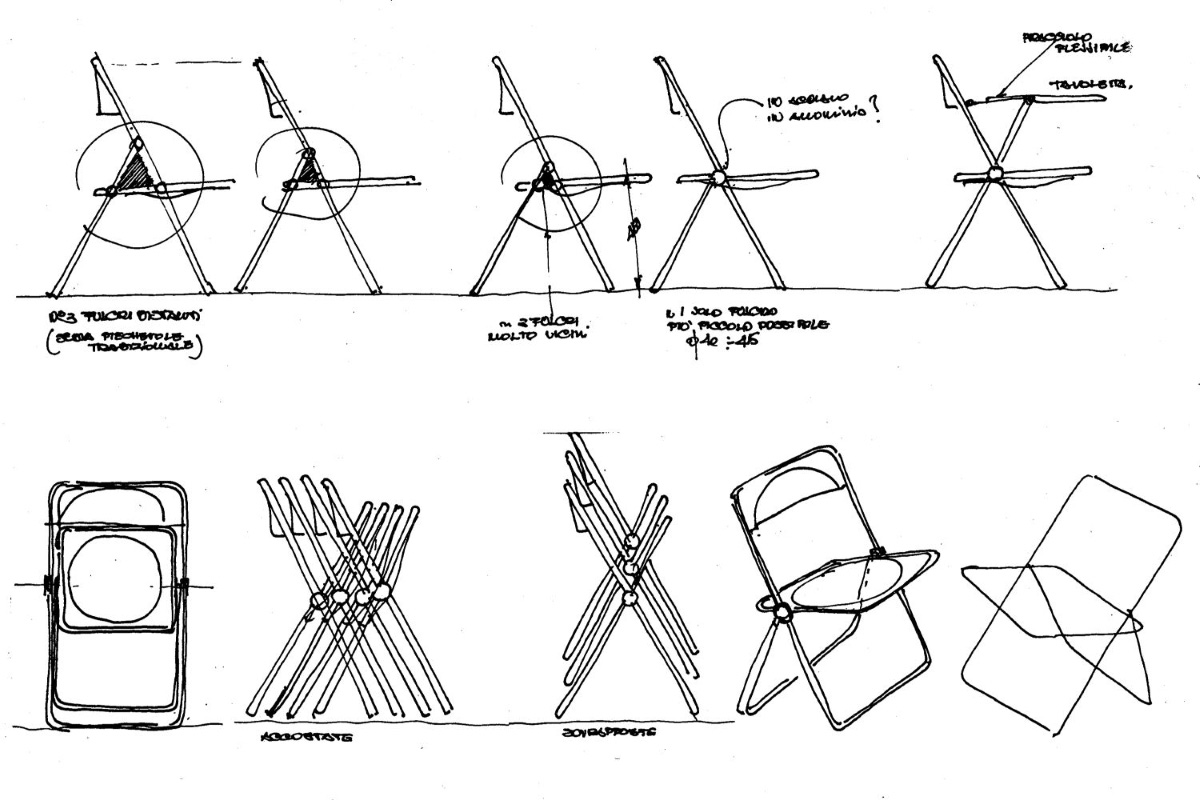
The true innovation of Plia lies in its mechanism: a hinge that allows the chair to fold while also making it stackable. A small engineering detail that becomes a powerful design gesture, capable of solving concrete issues such as space, mobility, and flexibility with remarkable ease. Plia opens when needed and disappears when it is not, occupying only what is essential and quietly supporting daily life.
Material choice plays a key role in this revolution. The use of transparent polycarbonate visually lightens the object, allowing light to pass through and reducing its spatial impact. Plia blends seamlessly into both domestic and collective environments — homes, offices, conference rooms, public spaces — without ever dominating them. It is refined yet accessible, designed to be democratic, reproducible, and widely used.
Trained as an architect, Giancarlo Piretti brought a structural and rational approach to industrial design, where function always precedes form. Plia perfectly embodies this vision: a project in which technology, form, and use coincide without rhetoric. Its success was immediate and enduring, with millions of units produced and inclusion in the permanent collections of major design institutions, from the Museum of Modern Art in New York to the Triennale di Milano.
© Giancarlo Piretti
Yet despite this recognition, Plia never became a loud icon. It remained discreet, almost anonymous, as if its strength lay precisely in its ability to be used, lived with, and worn by time. A rare quality, especially today, in an era when design is often expected to perform and attract attention.
Plia is not an isolated achievement, but the most recognizable expression of a coherent and rigorous body of work. Building on the same principles of mechanical intelligence and lightness, Piretti developed a series of equally emblematic objects: the Plano and Platone tables, the Planta coat stand, the Pluvium umbrella stand, and the Plona chair. Different in function and scale, these designs share a common attitude, reflected in the “pl” prefix derived from the French word pliant, meaning foldable and transformable.
Alongside these products, Piretti explored modular systems with great clarity, as in Sistema 61, anticipating a flexible and open concept of living able to adapt to the changing needs of contemporary life. His work consistently looks to the future while remaining grounded in precision and constructive logic.

© Giancarlo Piretti
The passing of Giancarlo Piretti marks the loss of one of the most lucid minds in Italian design, yet his work continues to speak to us with the same quiet strength that accompanied everyday life for decades. His light, essential, and intelligent forms remind us that truly lasting design does not impose itself — it moves naturally through time, subtly improving the way we live with objects.


 Iscriviti alla nostra newsletter