At the Museum der Kulturen in Basel, Our Owl Is Pink reveals everything colour can communicate beyond appearances
Colour seems immediate. We recognise it before we can even describe it, using it to find our way, dress, furnish our homes and communicate emotions and identities. Yet what we see never has an entirely universal meaning. A shade associated with celebration in one part of the world may evoke mourning, protection, spirituality or conflict elsewhere. It is within this gap between perception and interpretation that Our Owl Is Pink – Colourful Stories takes shape, the exhibition now open at the Museum der Kulturen in Basel until 24 January 2027. Around two hundred objects from different geographical contexts come together in a narrative that approaches colour not simply as an aesthetic quality, but as a cultural phenomenon: a tool capable of shaping identities, expressing collective values and making social and political relationships visible.
Courtesy of Museum der Kulturen Basel
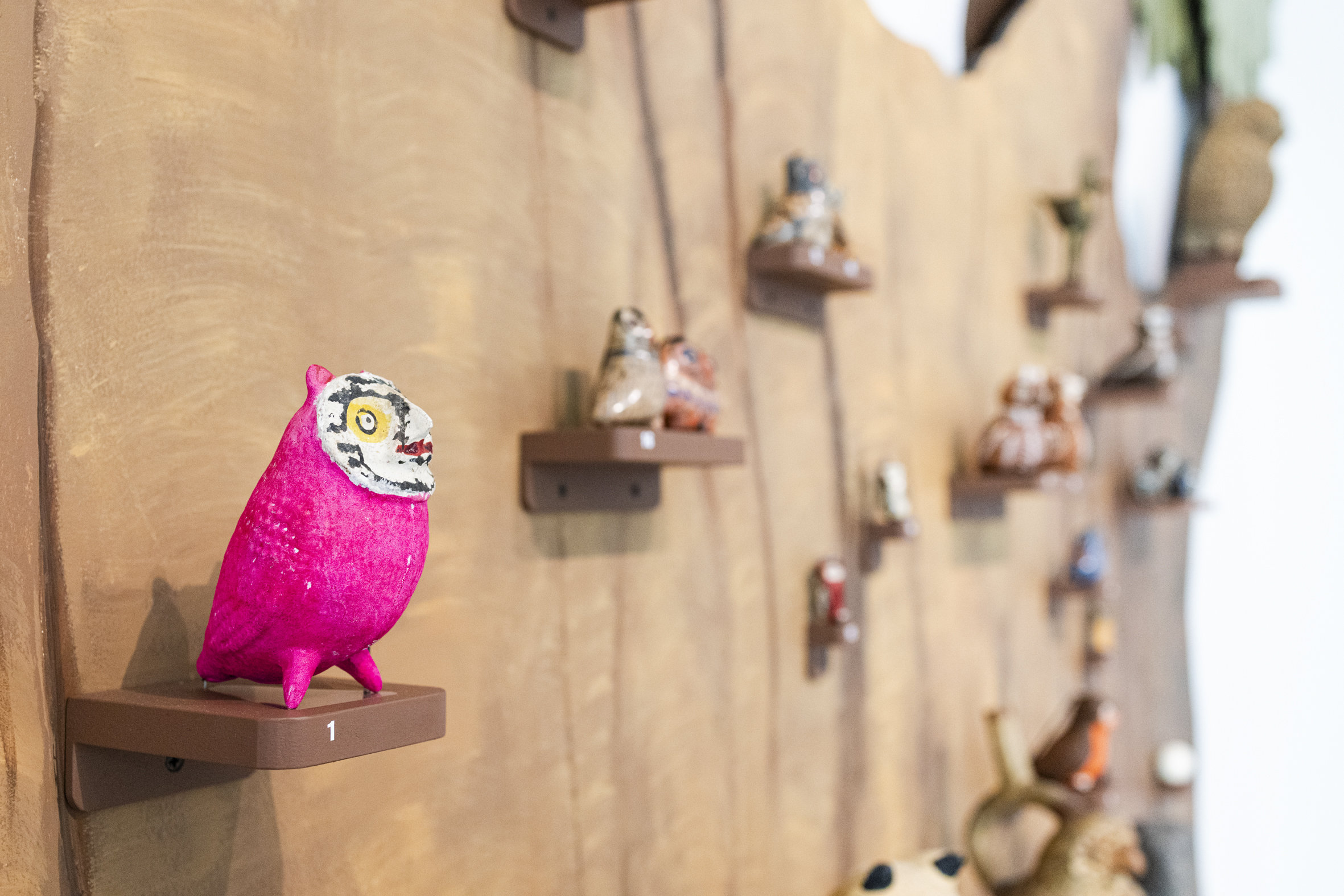
Visitors are welcomed by the small pink owl that gives the exhibition its title. Originating from Mexico, it immediately stands out among figures with more subdued plumage in shades of white, grey and brown. A small yet eloquent presence, it was chosen precisely for its ability to defy expectations. Its pink colour makes it different and instantly recognisable, almost as though it possessed a personality of its own. From here, the exhibition opens onto a world in which colours do not simply decorate objects, but alter their character and role. Basel carnival masks, batik fabrics and numerous artefacts reveal how much labour, technique and knowledge are required to achieve a particular chromatic intensity. Matter, form and surface may exist without colour, yet it is often colour that makes them memorable, ritualistic or symbolically powerful.
The exhibition focuses above all on colour’s ability to generate collective meanings. Embroidered Ukrainian shirts, known as vyshyvanka, are presented not only as expressions of textile tradition, but also as contemporary symbols of solidarity and resistance. In Mexico, by contrast, rosa mexicano conveys a vibrant, intense and openly optimistic attitude to life. Colour can protect, celebrate, reinforce faith or create a sense of belonging. It may signal a political stance, preserve a memory or become part of a strategy of identity. The same shade changes meaning according to culture, personal history and the conditions through which it is perceived. For this reason, Our Owl Is Pink avoids offering a rigid interpretation or a definitive dictionary of colours. Instead, it shows how every association depends on context. Red, blue, green and yellow are not neutral categories, but surfaces onto which communities project fears, desires, hierarchies and hopes.
Behind the seduction of the brightest hues lies an economic and material history. The production of pigments and dyes, once expensive and complex, changed radically with the development of synthetic substances from the mid-nineteenth century onwards. Greater availability lowered prices and expanded consumption, while at the same time intensifying the trade in the materials required for their production. The exhibition reconstructs this transformation without separating it from the colonial system within which many resources were extracted, processed and exchanged. Colour thus becomes an entry point into a history also shaped by exploitation, control over raw materials and environmental consequences that continue to be felt today. This is one of the exhibition’s most compelling aspects: the reminder that what appears immaterial and almost natural is in fact produced through technical processes, economic supply chains and power relations.
The exhibition design was developed with the involvement of children and people who are blind, visually impaired, deaf or hard of hearing. This was not an addition made at a later stage, but a process of exchange that helped shape both the form and content of the project. Easy-to-read texts, audio guides, sign-language videos and interactive stations create an experience that does not rely exclusively on sight. In the final room, the Creative Space invites visitors to translate emotions such as joy, love and anger into colours and forms. Their contributions gradually become part of the display, transforming the exhibition into an open and evolving organism. Our Owl Is Pink instead offers a constellation of stories, techniques and perspectives, showing how our relationship with colour is always personal and, at the same time, deeply cultural. Colour does more than transform what we see: it also reveals the conventions, memories and experiences through which we learn to interpret the world.
Museum der Kulturen Basel


 Iscriviti alla nostra newsletter