Via dei Pestagalli, 31,
20138 Milano MI
Colombo's Archive, a new research and consultation space founded by Antonio Colombo, opens in Milan, a collection that spans more than a century of industrial and design history
The history of tubular steel runs through some of the most significant transformations in twentieth-century design, from modern furniture and architecture to cycling, where the material's technical possibilities opened new avenues for experimentation. An important part of this story can now be discovered at Colombo's Archive, which opened in Milan on 20 October, bringing together documents, prototypes, drawings, furniture, photographs and artworks connected to the Colombo family and its businesses. The story began in 1919, when Angelo Luigi Colombo founded A.L. Colombo in Milan, a company specialising in steel tubing and special alloys. In the 1930s, the business expanded into tubular steel furniture under the Columbus brand, collaborating with leading figures in modern architecture, including Marcel Breuer, Giuseppe Pagano, Giuseppe Terragni, Piero Bottoni, Luigi Figini and Gino Pollini. Chairs, armchairs and accessories emerged from the combination of manufacturing expertise and formal research, at a time when industrial production was becoming an integral part of design culture. By the time Antonio Colombo joined the family business, little remained of this earlier period beyond prototypes, structures and materials stored in the workshops. In his autobiographical account, Colombo's True Story, he recalls the workers who continued to produce lightweight tubes “slowly, carefully and quietly”, almost caressing them as they worked. The image conveys the value of a technical expertise that risked disappearing as the industrial landscape changed.
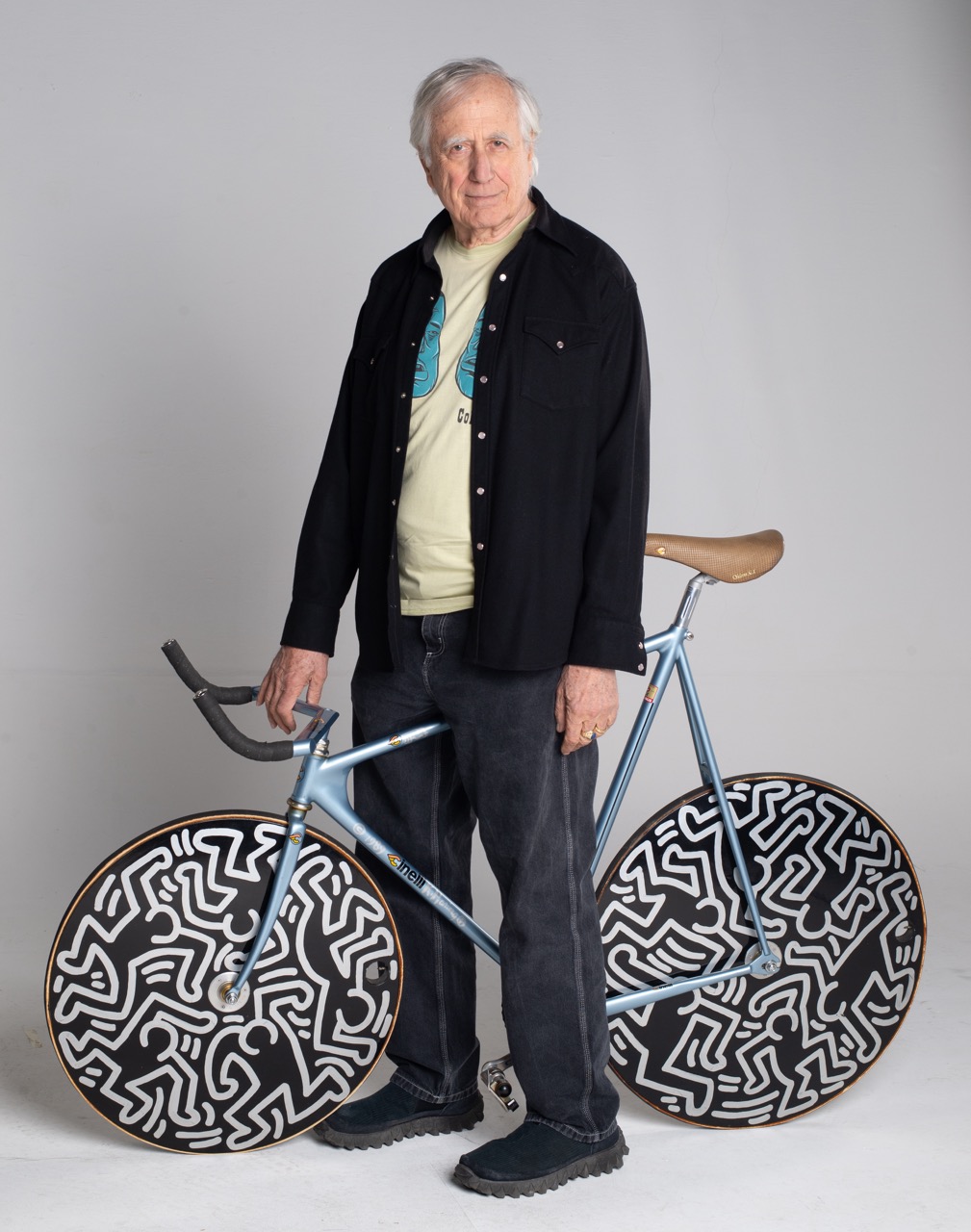
Antonio Colombo and Keith Haring Laser, 2026, ph Marcello Manca
The history of tubular steel runs through some of the most significant transformations in twentieth-century design, from modern furniture and architecture to cycling, where the material's technical possibilities opened new avenues for experimentation. An important part of this story can now be discovered at Colombo's Archive, which opened in Milan on 20 October, bringing together documents, prototypes, drawings, furniture, photographs and artworks connected to the Colombo family and its businesses. The story began in 1919, when Angelo Luigi Colombo founded A.L. Colombo in Milan, a company specialising in steel tubing and special alloys. In the 1930s, the business expanded into tubular steel furniture under the Columbus brand, collaborating with leading figures in modern architecture, including Marcel Breuer, Giuseppe Pagano, Giuseppe Terragni, Piero Bottoni, Luigi Figini and Gino Pollini. Chairs, armchairs and accessories emerged from the combination of manufacturing expertise and formal research, at a time when industrial production was becoming an integral part of design culture. By the time Antonio Colombo joined the family business, little remained of this earlier period beyond prototypes, structures and materials stored in the workshops. In his autobiographical account, Colombo's True Story, he recalls the workers who continued to produce lightweight tubes “slowly, carefully and quietly”, almost caressing them as they worked. The image conveys the value of a technical expertise that risked disappearing as the industrial landscape changed.
In 1976, Antonio Colombo launched Columbus Tubi Speciali per Biciclette Speciali, and the following year acquired Cinelli, bringing a sensibility that combined technical innovation, design and visual culture into the world of cycling. During the 1980s, collaborations with Alessandro Guerriero and the Alchimia group, together with the work of designers and artists, turned the bicycle into a field of aesthetic experimentation. Projects such as the Rampichino and the Cinelli Laser exemplify this research, while bicycles developed in collaboration with artists introduced new visual languages to the sector.
Colombo's meeting with Keith Haring in Milan in 1984 marked an important moment in this journey, which found one of its best-known expressions in the Laser associated with the artist. At the same time, Colombo's interest in contemporary art grew, leading to the opening of his gallery in 1998. This convergence of interests defines the identity of the archive, which brings together original furniture, technical drawings, catalogues, photographs, bicycles, posters, trophies and artworks. Among the objects documented in the exhibition are the Columbus 31C chair from the 1930s, drawings by Giuseppe Terragni, Alessandro Guerriero's studies for the 1984 Super Corsa and a lenticular wheel created by Alchimia in the 1980s. Seen together, these objects trace the passage from industrial expertise to formal research, and from product design to the construction of visual identity. In the text accompanying the opening, Marco Sammicheli describes Colombo's Archive as the result of a particular way of seeing, one that recognises the value of industrial objects beyond their original function. The collection becomes a resource for understanding the cultural, technical and production contexts in which design takes shape, bringing attention to the people and processes behind each object.
The archive was born from a practical need: after decades of activity, Antonio Colombo found himself with thousands of documents and hundreds of objects accumulated over time, all bearing witness to an industrial and personal history that deserved to be organised and made accessible. Developed with the collaboration and curatorship of Melania Andronic, the project occupies premises at 31 Via dei Pestagalli, previously used by the company from the late 1970s until the 1990s. In his text, Colombo describes his intention to “inform and share a memory” that has accompanied him throughout his life, rescuing these materials from dispersal and making them available for consultation. Sammicheli likewise connects the project's significance to the transmission of design culture through the memory of businesses and their products. Colombo's Archive thus offers a new destination in Milan for anyone interested in design, architecture, cycling and contemporary art, bringing together a collection that crosses disciplines and generations. Open for consultation by appointment, the space offers a closer look at a story in which a family business intersects with the evolution of Italian visual culture. Drawings, prototypes, photographs and artworks come together to reveal the connections between industry and creativity, showing how manufacturing expertise can generate forms and languages that leave a lasting mark.
Photo credits:
Installation photo © Marcello Manca
Photos by Antonio Colombo and Alessandra Cusatelli - *The Last Waltz*, 2023. Colombo's Archive
Photo of the RVCA Supercorsa by Barry McGee, 2008. Colombo’s Archive
Work in progress, 2025, photo by Filippo de Bernardi. Colombo’s Archive
Columbus Technical Office, 31C spring chair, 1930s, manufactured by Columbus, photo by Pier Maulini. Colombo’s Archive
Columbus Technical Office, Small Chair and Side Table for the Gaslini Institute in Genoa, 1937, manufactured by Columbus, photo by Pier Maulini. Colombo’s Archive
Columbus Technical Office, 50C Spring Chair, 5th Milan Triennale, 1933, manufactured by Columbus, photo by Pier Maulini. Colombo’s Archive
Columbus Technical Office, Round coffee table, 1930s, manufactured by Columbus, photo by Pier Maulini. Colombo’s Archive
Columbus Technical Office, 210C flower vase holder, 1935, manufactured by Columbus, photo by Pier Maulini. Colombo’s Archive
Columbus Technical Office, Steel umbrella stand, 1930s, manufactured by Columbus, with wooden template for bending the tubes, photo by Pier Maulini


 Iscriviti alla nostra newsletter