Via Santa Marta, 14
Milano
In Milan’s Cinque Vie district, Marocchino:Hebel brings together modernist furniture, works on paper and contemporary ceramics, exploring the relationships between objects, materials and the spaces they inhabit.
At Via Santa Marta 14, in Milan’s Cinque Vie district, Marocchino:Hebel Gallery emerges from the meeting of two different backgrounds and a shared interest in objects, materials and the environments they shape. Michele Marocchino, a collector with a particular interest in twentieth-century interiors, and Stefanie Hebel, with extensive experience in fashion and retail, have created a space bringing together modernist design, works on paper and contemporary ceramics. The decision to combine these disciplines suggests an approach to design that moves beyond the distinctions between furniture, art and applied arts, shifting the focus to how objects coexist and contribute to the character of an interior.
One of the project’s starting points is Casa di Fantasia, the Milan apartment designed by Gio Ponti in 1952 for the Lucano family, acquired by Marocchino in 2019 and subsequently reinterpreted by interior designers David/Nicolas. More than a historical reference, this experience offers a lesson in how to live with objects and shape an interior through combinations of materials, forms and details that stand the test of time. This perspective informs the gallery’s research, which focuses primarily on Italian and international Mid-Century Modern design, spanning the 1920s to the 1970s and encompassing diverse geographies, from Italy and Denmark to France and Brazil.
The selection includes designers and makers such as Franco Albini, Gio Ponti, Aldo Tura, Gigi Radice, Willy Rizzo, Massimo Vignelli, Vico Magistretti and Venini, alongside international figures including Marcel Breuer, Finn Juhl, Hans Wegner, Isamu Noguchi, Jean Prouvé, Sergio Rodrigues and Jorge Zalszupin. The reputation of a designer is only one factor in the selection. Equal attention is paid to unusual variants, craftsmanship, wood species and the distinctive features that set individual pieces apart from more familiar examples of their production. An object’s value thus emerges from the interplay of design, workmanship, conservation and history, rather than resting solely on the name attached to it.
Here, the arrangement of the pieces becomes an integral part of the narrative. A Brazilian modernist sofa might be placed alongside a 1913 drawing by Picasso, while chairs designed by Gio Ponti for a private Milanese residence can be paired with contemporary upholstery fabric. These combinations recall the work of interior designers who build spaces by layering different periods and visual languages, without seeking a literal correspondence between every element.
A historic object retains its identity while acquiring new possibilities for interpretation when removed from the isolation typical of museum displays or conventional retail settings. The presence of works on paper and contemporary ceramics further expands this approach. Drawings, prints and studies introduce a graphic dimension, while ceramics foreground the relationship between material, gesture and sculptural form. The dialogue between these works and the furniture creates common ground in which function is no longer the sole criterion for understanding an object. Formal quality, technique, surface and the relationship with the surrounding space become equally significant. This perspective is particularly relevant at a time when collectible design is moving across different contexts, from specialist galleries and international fairs to residential and hospitality projects.
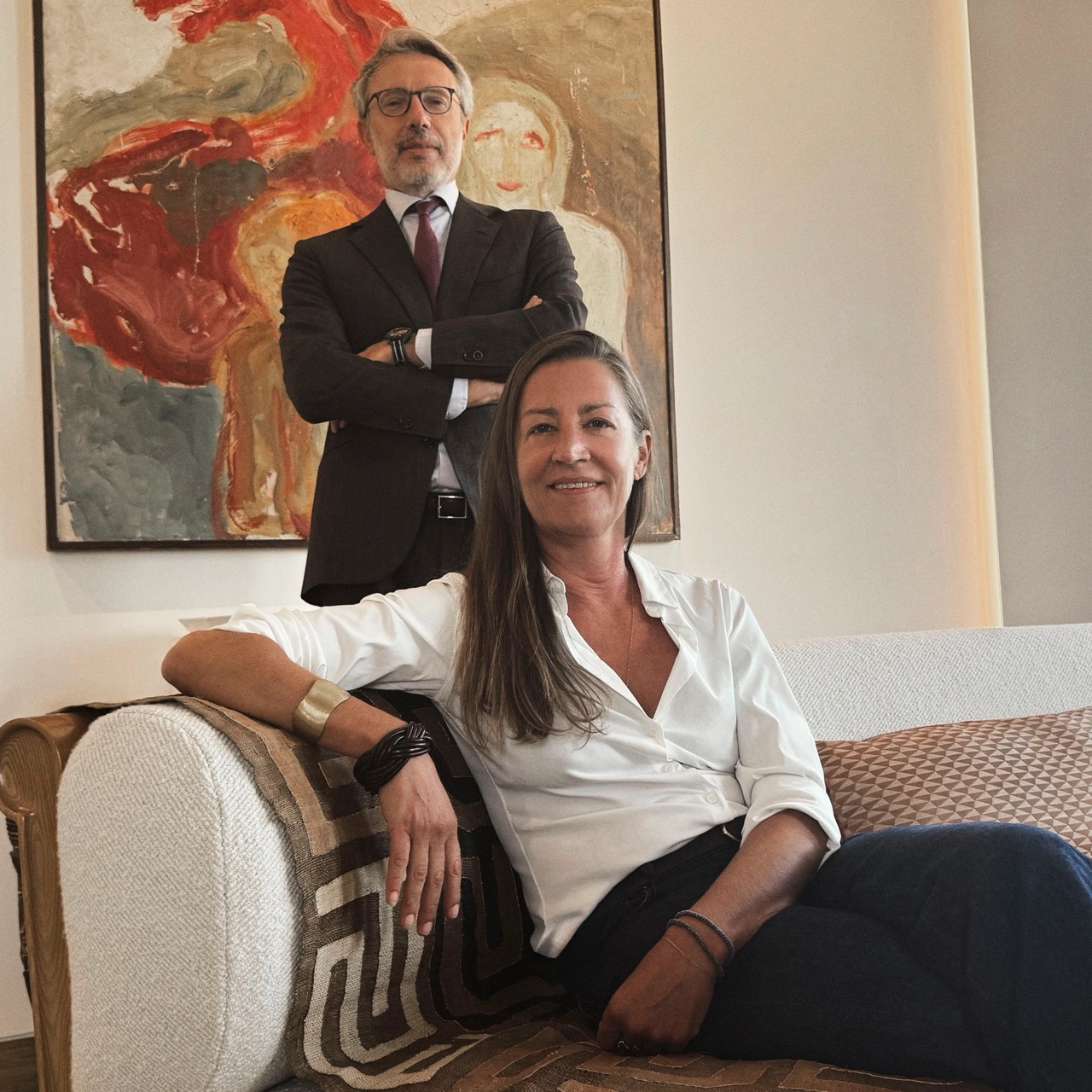 Michele Marocchino e Stefanie Hebel
Marocchino:Hebel’s research seems to focus precisely on this space of relationships, appealing to architects, interior designers and collectors interested in creating personal interiors rather than simply accumulating iconic pieces. The restoration of historic furniture is another important aspect of the project. Before entering the gallery, each piece is assessed to establish its condition and identify the work required, with interventions entrusted to specialist restorers and upholsterers and aimed at preserving its original character. Conservation, in this context, does not necessarily mean returning an object to some hypothetical original state. It means understanding its history, distinguishing the marks of time from actual damage, and intervening without erasing the features that define its identity. Materials, construction techniques and often-overlooked details thus become part of a broader understanding of the design, as well as essential elements in establishing its authenticity.


 Iscriviti alla nostra newsletter