From Arcipelago Botanico for Portrait Milano, the artist’s work depicts a process in which an idea is constantly transforming, taking shape through a dialogue with places, people, and materials
There are artists who choose to occupy a space, and others who prefer to transform it — not through the force of a monumental gesture, but by radically changing how that place is perceived, moved through, and inhabited. Agostino Iacurci belongs to this second category: an author capable of working on the city as if it were a true design material, intervening with discretion to generate new and unexpected relationships between people, architecture, and the surrounding landscape.
The new installation Arcipelago Botanico (Botanical Archipelago), inaugurated in the square of Portrait Milano, represents a further and significant step in this journey. Eight large plant-like sculptures transform the ancient courtyard of the former Archbishop's Seminary into an imaginary garden, born from an intimate dialogue with the site's historical memory and its contemporary layout. More than a simple temporary installation, the work functions as a spatial device that invites passersby to slow down, pause, and redefine their relationship with the square. However, simply describing the work would mean missing what is perhaps the most interesting aspect of Iacurci's practice — namely, his method. In recent years his visual language has gradually moved away from the mural understood as pure image, drawing closer to a practice he himself defines as a form of "expanded painting." Painting, sculpture, installation, stage design, and public space thus become tiles of a single design mosaic, in which every intervention arises from careful listening to context even before formal intuition. In conversations about his research, Iacurci often describes how each project begins long before the drawing stage, nourished by time spent in places, by gathering stories, and by daily observation of the people who inhabit them. The work never arrives to impose an alien vision, but to make legible relationships that were already present beneath the surface — turning public space into the true material of the project, and bringing his path surprisingly close to that of design.
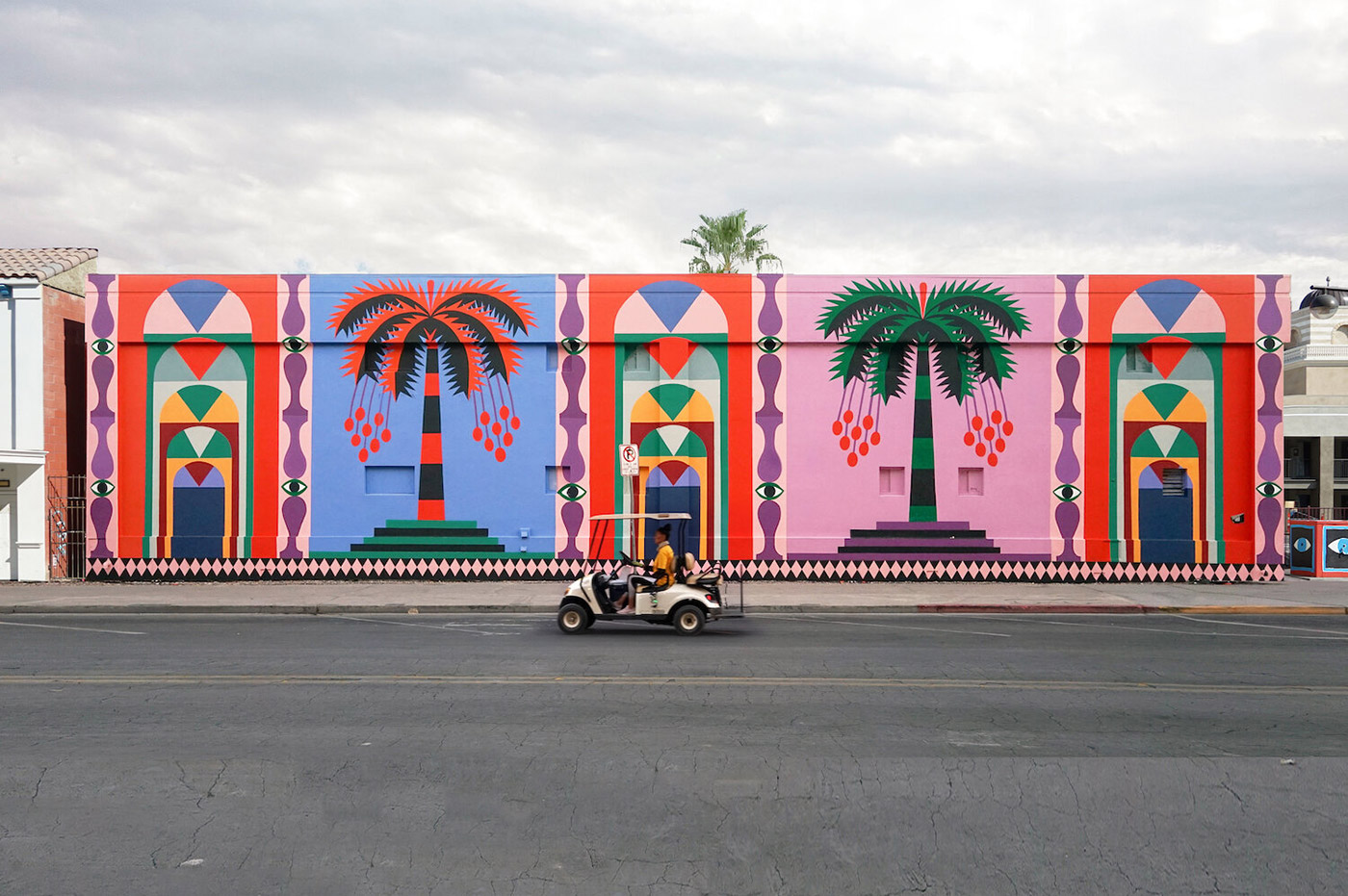
Las Vegas 2021
As happens in the best creative processes, in Iacurci's work too the final result represents only the last phase of a much more layered research. The idea changes constantly along the way, in dialogue with the history of places, with technical constraints, with available materials, and above all with the people involved in bringing it to life; the project, in the end, never coincides with the initial drawing, but with the very process that allows that intuition to become reality. From this perspective, Arcipelago Botanico is not simply an artistic intervention conceived for Portrait Milano, but an example of how contemporary art can contribute to building new urban geographies. His large imaginary plants do not enclose a space but make it more permeable, introducing new thresholds, new places to pause, and unexpected possibilities for encounter. It is an apparently simple gesture that nonetheless changes people's behavior, restoring to the square a dimension of proximity and sharing that fully embraces the public vocation Portrait Milano is progressively building. This is the same approach that in recent years has led Iacurci to engage with companies and institutions without ever giving up his own expressive autonomy. During Milan Design Week, his work has repeatedly become a valuable occasion for dialogue with the world of design: from the large installation Dry Days, Tropical Nights, created in 2023 for GLO in the Largo Treves building in Brera, to more recent collaborations — each intervention comes to life from the fortunate meeting of artistic research, production capability, and technical experimentation.
In this scenario another protagonist emerges, often invisible but fundamental, who makes the physical construction of the work possible. Behind the visual lightness of Iacurci's installations lies a long process of engineering, prototyping, and production, in which companies and manufacturers become an integral part of the creative thinking.
In the case of Arcipelago Botanico, as had already happened in the past for projects created during Fuorisalone, this dialogue found in Pollodesign a partner capable of translating an apparently simple image into a complex constructive system. This is a step rarely covered in the press, yet it represents one of the most fascinating aspects of the contemporary relationship between art and design. The work no longer arises solely in the solitude of the artist's studio, but takes shape through ongoing dialogue with those who deeply understand materials, technologies, and production flows — to the point that production is not a phase that follows the idea, but an integral part of the original thinking.
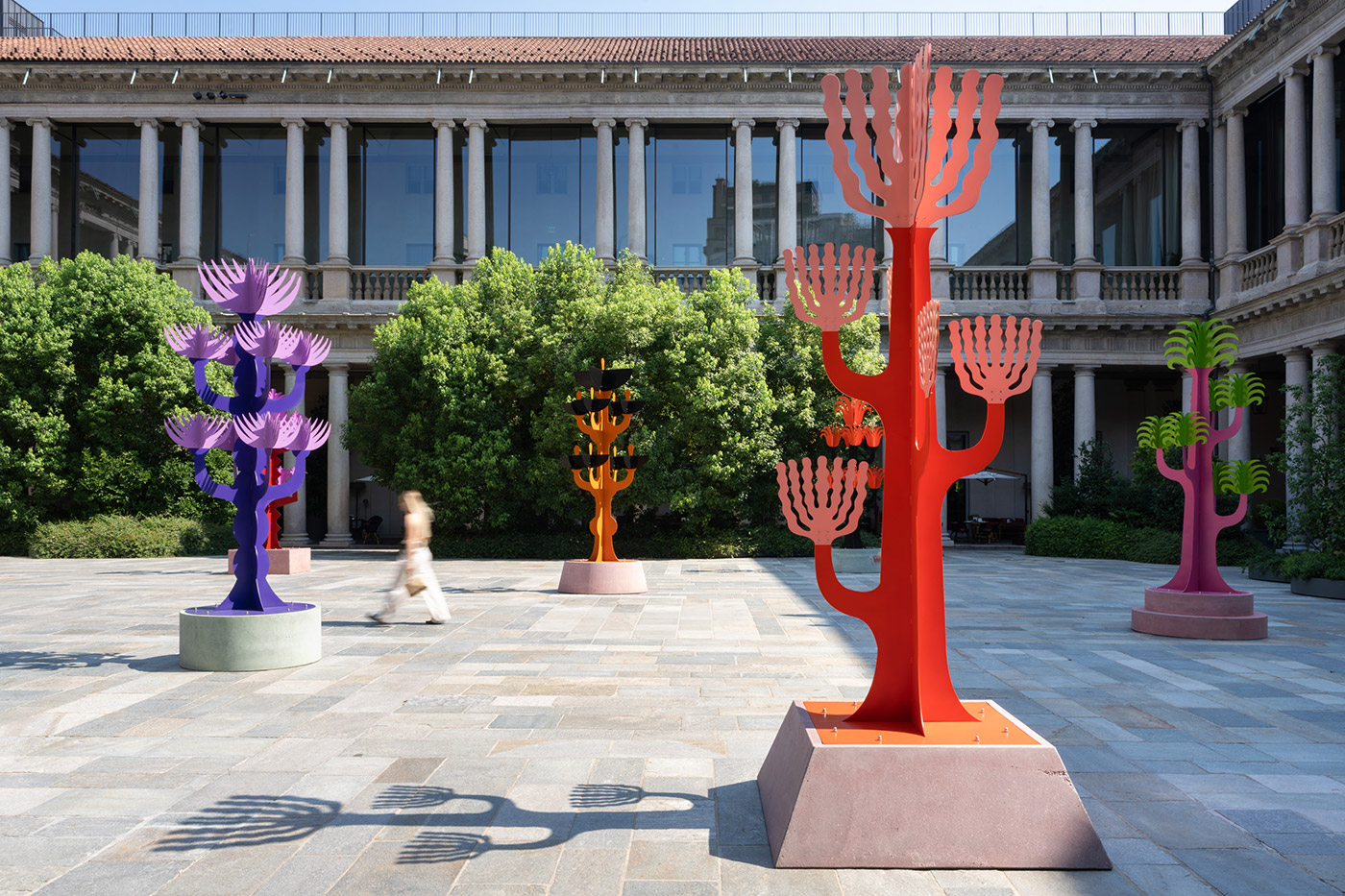
"Arcipelago Botanico" - Ph Lorenzo Palmieri
In this sense, the work of Andrea Gallo and Pollodesign does not simply consist of "realizing" a work, but of actively participating in its construction, turning poetic intuitions into structurally viable elements without ever betraying their expressive force. It is a space of mediation that is becoming increasingly central to contemporary design culture, one in which artistic, industrial, and craft competencies blend until they become almost indistinguishable. Perhaps it is precisely here that Agostino Iacurci's work truly meets design: not so much in the form of his works, but in the method by which they are built. A method made of listening, dialogue, experimentation, and collaboration, in which the finished work represents only the tip of the iceberg of a much broader process — one capable of producing not just objects or installations, but new possibilities for living shared space.
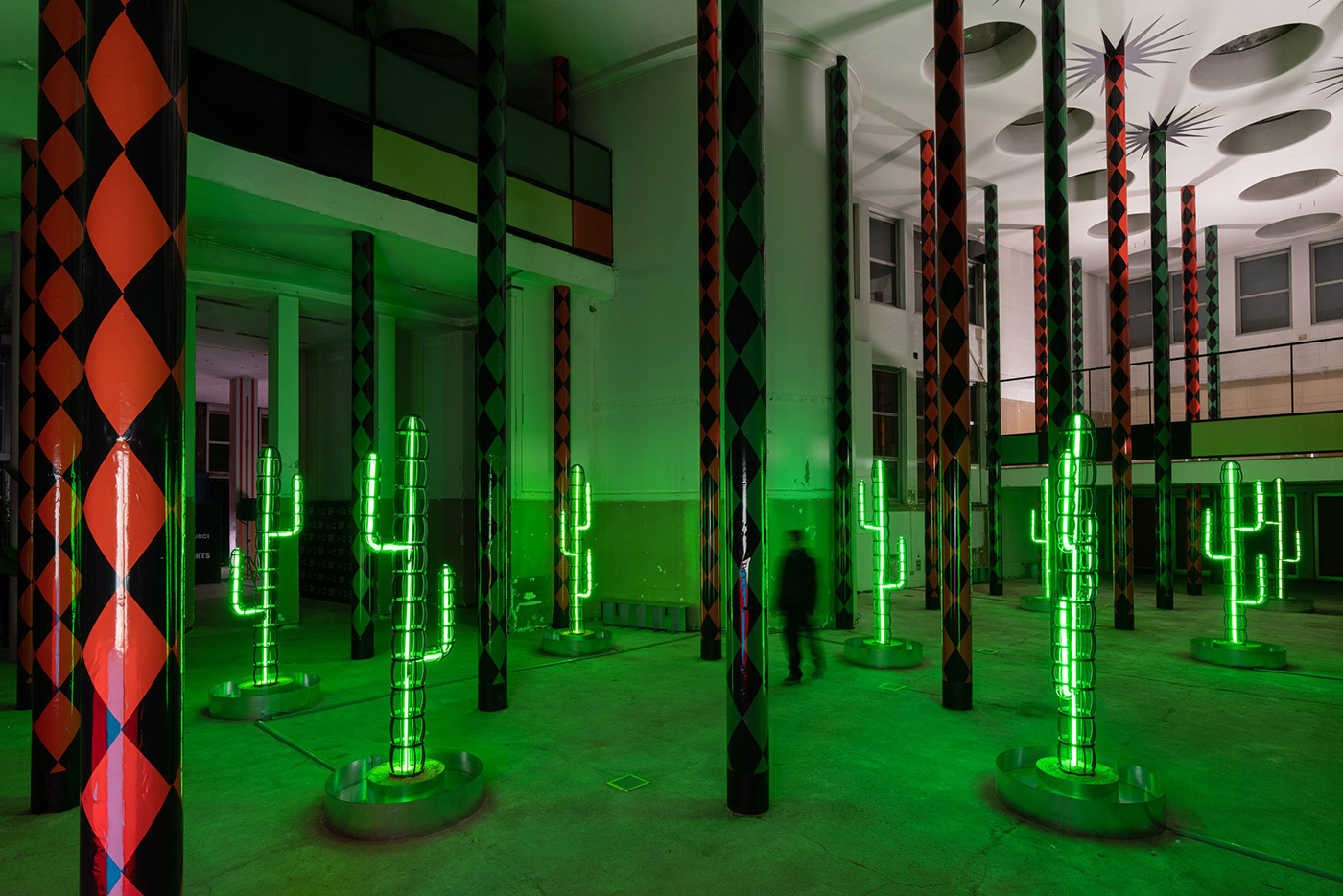
"Dry Days, Tropical Nights" - Ph Lorenzo Palmieri
Interview with Agostino Iacurci
In your work, public space seems to be the true material of the project. How much time do you dedicate to listening to a place before you even begin to draw it, and how do you know when that place has finally started speaking to you?
There's no set amount of time. I try to use all the time I have available to research: doing preparatory studies, breathing in a place's air, observing its light, talking to as many people as possible. More than total understanding, I look for a foothold — something that resonates with me and with my work. Little by little the projects take shape, but until they're finished they remain a mystery even to me, the one making them. I often think of Pinocchio: you think you're building a puppet, putting together four pieces of wood; when you believe you're done, you find yourself facing a living creature. At that point the work begins to have a life of its own: it meets people, is walked through, interpreted, changes over time. And you keep observing it, learning to let it go.
Your works stand out for their lightness and immediacy, but behind the scenes there's a long process of dialogue with technicians, craftsmen, and manufacturers. How does this phase shape the initial idea, and has a construction constraint ever turned into an unexpected creative opportunity?
Translating a thought into physical objects is a continuous exercise in mediation. On a small scale this happens with one's own limits and means; on a large scale you're dealing with the limits of everyone involved, but also with the technical and regulatory constraints of a space — from a floor's load capacity to the wind resistance of an 800 kg sculpture four meters tall. When I use techniques I can't develop on my own, due to scale or complexity, it becomes essential to collaborate with people who embrace my vision but are also able to find effective solutions. In that process, new possibilities often emerge that modify and enrich the initial idea.
Many classify your work under public art, but looking closely it seems to increasingly resemble a true spatial design project. Do you recognize yourself in that definition, and where do you imagine this evolution might take you?
I dedicate myself to very different practices: painting in the studio, for instance, has little to do with public art. That's why I claim for myself the definition of "artist," which seems to me the broadest and freest one. The constant in my work is perhaps the attempt to project mental images into the physical world. Over the years the images have changed, and so have the means — from sheets of paper to the space of a square, as in the case of Portrait Milano. For this reason, more than "public art," the definition of "expanded painting" seems to me, in a sense, more fitting. Sometimes, jokingly, I like to say that more than an artist, I'm a projector.
Andrea Gallo (Pollodesign)'s point of view
Agostino Iacurci's works seem to arise from a simple, almost spontaneous gesture, yet behind them lies significant technical and production research. What is the deep value of this dialogue between artist and company, and to what extent does the ability to translate a poetic intuition into a buildable work represent, in itself, a genuine design project?
Before anything else, the company must know the artist, embrace their idea, and understand their language; only then can it study how to translate that language into a physical work. In this case the company cannot simply execute — it must draw on its own know-how and pass on to the artist and their works its design expertise and material knowledge, the fruit of ongoing research and development carried out over years. This culture of design and materials represents a cross-cutting wealth that the artist can draw on to experiment: through continuous dialogue between artist and designer, the initial idea has the chance to evolve, eventually taking shape in totally unexpected ways and forms — perhaps with a material or technique the artist hadn't imagined at all at the start of the process.
To sum up this synergy, I would say it's about "the art behind the art."


 Iscriviti alla nostra newsletter