Design is everywhere.
Yet we rarely call it design.
Beyond Design: what Design Economy 2026 really tells us about the present of Milan Design Week
A month after the presentation of the Design Economy 2026 report promoted by Fondazione Symbola, Deloitte Private, POLI.design and ADI, we took the time to look carefully not only at the research itself, but also at the articles, interviews and commentaries that, in the following weeks, expanded its interpretations and perspectives. Rather than simply summarizing the data, what interested us was trying to build a more reasoned reading of the themes that emerged, asking why so many of the issues addressed by the report now seem increasingly intertwined with the evolution of Milan Design Week itself.
Because when observing what happens in Milan during Salone and Fuorisalone, there is a growing sense that design has long exceeded the traditional boundaries of the discipline. No longer only product, furniture or industry, but a cultural platform, a transversal language, a relational infrastructure capable of moving across technology, services, fashion, sustainability, artificial intelligence, communication and urban space. Many of the recurring themes in the report, from the growing centrality of design within innovation processes to the difficulty of fully recognizing its role, up to the impact of AI on creative practices, seem to find during Milan Design Week a concrete, visible and often amplified manifestation.
Design Week therefore becomes not only the place where design is exhibited, but also a space where some of the most evident tensions and contradictions of contemporary culture emerge: the saturation of experience, the growing importance of curation, the role of brands as cultural actors, the construction of increasingly complex relational ecosystems, and the need for new digital infrastructures capable of orienting audiences and flows.
For this reason, it felt useful to slow down instead of consuming post-event data and trends at the usual speed, and try to connect some of the most interesting reflections emerging from the research with what Milan Design Week is becoming today. What follows is therefore not intended as either a review of the report or an exhaustive summary, but rather as an attempt to trace a few interpretative lines that may help frame the role of MDW within the broader transformations currently reshaping design.
Design as the invisible infrastructure of contemporary life
Italian design continues to grow. The numbers presented in the Design Economy 2026 report confirm it clearly: €4 billion in added value, 54,000 operators, 76,000 employees and a European leadership position that sees Italy ranking first both in employment and economic relevance within the sector.
At a European level, the industry counts around 295,000 companies, generates €31 billion in revenue and employs more than 356,000 people, with significant growth over the last three years. Italy alone produces 20% of Europe’s design value and accounts for 21.5% of total EU employment in the sector, ahead of France and Germany.
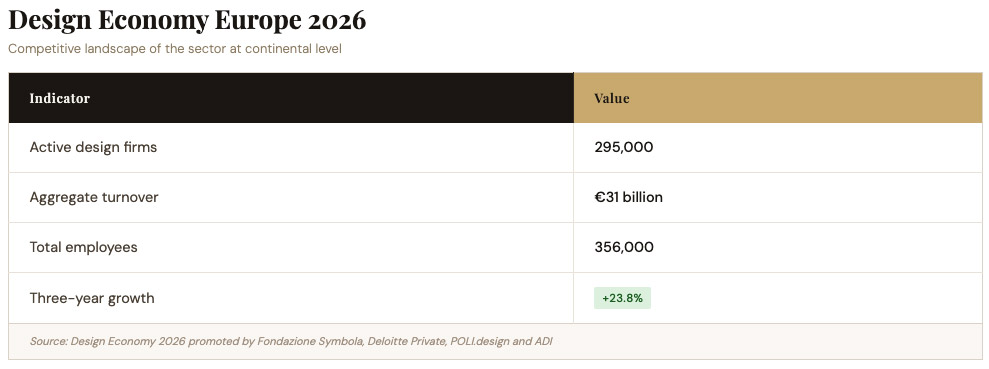
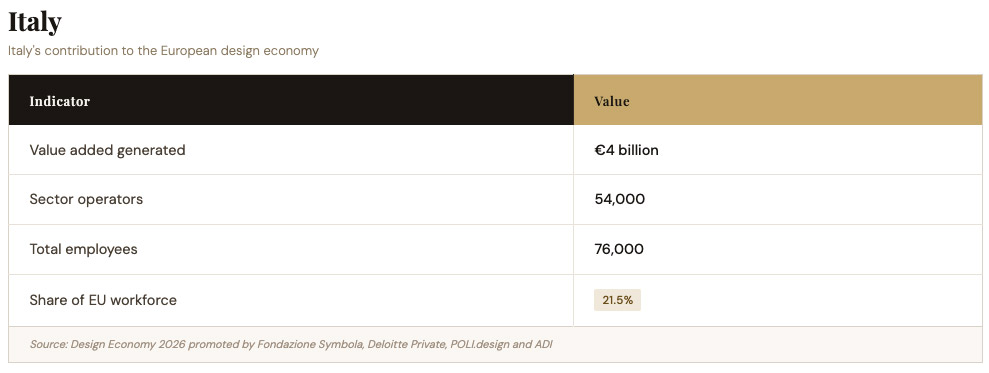
Yet the most interesting part of the research is not simply its economic dimension. The central theme emerging from the debate promoted by Fondazione Symbola, Deloitte Private, POLI.design and ADI is much deeper: design today is everywhere, yet it is often not recognized as design. This is the core paradox of the report.
Companies increasingly seek design-related skills, but rarely define them as such. The analysis of over 17,000 job offers shows that the market demands abilities connected to design thinking, service design, user experience, digital systems, complexity management, while describing them through managerial, organizational or technological vocabularies instead.
As Domenico Sturabotti of Fondazione Symbola observed, “the market often asks for designers’ skills while using different terms to describe them.” Luciano Galimberti, president of ADI, pushed this reflection even further: the issue is not only communicative, but cultural. In Italy, designers are still frequently imagined as vague creative figures, while contemporary design has become a systemic practice crossing production, services, technology, public administration and social innovation.
This is where the report introduces one of its most interesting concepts: “unconscious design”.
According to Ermete Realacci, large parts of the Italian economy make use of design without explicitly naming it. This is true of sectors connected to yachting, specialized manufacturing, fashion or furniture production: worlds in which design is central, even if the role of the designer often remains formally absent.
This invisibility says something important about the Italian model. Design operates not only as an autonomous sector, but as a widespread infrastructure of Made in Italy itself the invisible system connecting manufacturing, material culture, quality, innovation and desirability.
For this reason, Realacci defines design as an “immaterial infrastructure of Made in Italy.”
Design as a culture of complexity
The real transformation described by the report concerns the meaning of innovation itself. For a long time innovation mainly meant: greater efficiency, increased production capacity, new technologies and industrial performance.
Today, however, design operates within a much more complex landscape where sustainability, digital transition, quality of life, social behaviors, technological platforms and systems thinking are deeply interconnected. Within this context, the role of the designer changes profoundly. Designers are no longer simply authors of objects, but cultural mediators capable of connecting different competencies, translating complex systems and making invisible transformations understandable.
This is perhaps also the most useful lens through which to read contemporary Milan Design Week. Over the years, MDW has progressively ceased to be merely an event dedicated to industrial design. What happens in Milan today resembles much more a distributed cultural platform able to connect fashion, technology, hospitality, luxury, automotive, publishing, AI and entertainment.
Design increasingly appears as the common language through which very different industries attempt to build cultural relevance. It is no coincidence that many of the most visited and shared installations now belong to fashion and luxury brands. As Domus recently wrote about MDW 2026, “fashion is no longer a guest: it has become the system.” A sentence that perfectly summarizes how design is evolving from discipline into relational and narrative platform.
Milan as a cultural infrastructure
The report confirms Milan’s absolute centrality within the Italian and European design system. The city alone generates 19% of the national sector’s wealth and concentrates 14.3% of total Italian employment in design, with more than 7,300 active companies.
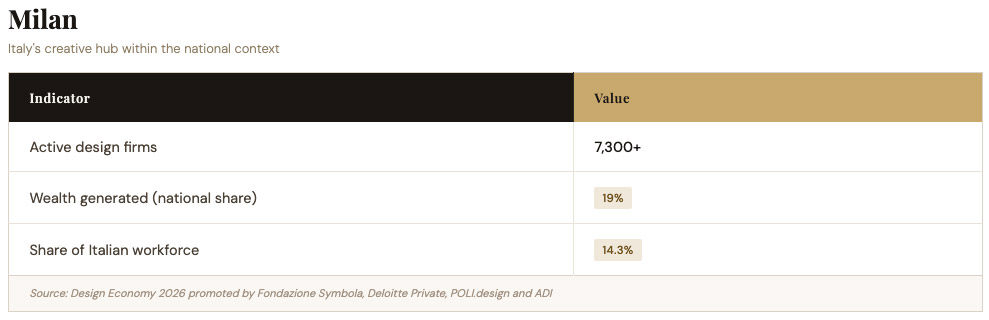
Yet Milan’s leadership cannot be reduced to numbers alone. The city functions because it succeeds in connecting production, education, communication, publishing, fashion, luxury, international relations and design research into a single ecosystem.
The strength of Milan Design Week lies precisely in this overlap of layers. The city no longer acts simply as the background for events: it has become a narrative and relational infrastructure in itself. Many of the themes emerging from the report become visibly tangible during MDW: the growing importance of experience, the construction of cultural ecosystems, the strategic role of brands, and the merging of physical and digital dimensions.
AI, acceleration and the risk of superficiality
One of the most interesting chapters of the research concerns the relationship between design and artificial intelligence. The picture that emerges is far less ideological than much of the public debate surrounding AI. Artificial intelligence is perceived mainly as a process accelerator and operational tool rather than as a creative substitute for designers. 65% of operators use AI tools regularly, while 94% claim to have consolidated AI-related competencies over the last two years.
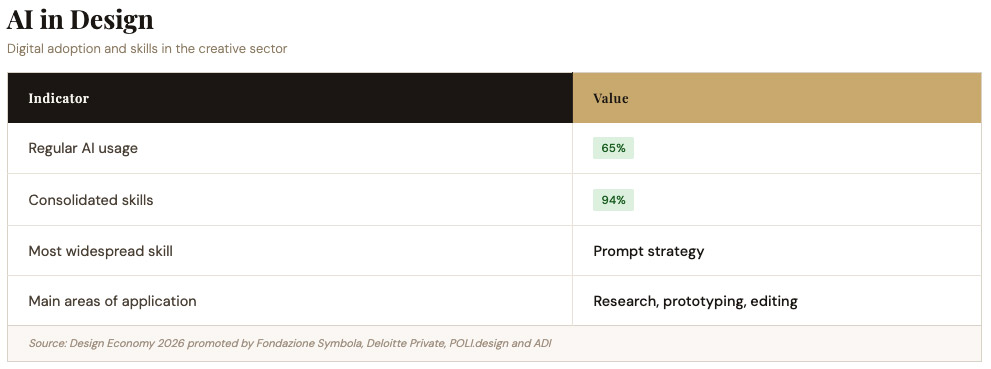
The most common uses concern: research, prototyping, visualization, customization and content editing, much more than autonomous idea generation.
This is where some of the report’s most interesting reflections emerge. According to Cabirio Cautela, GenAI is perceived mainly as an “efficiency partner,” while genuinely creative work remains associated with human designers. Valentino Caporizzi pushes this reflection further, warning about the risk of producing “an enormous amount of designed nothingness.”
This issue is particularly relevant for Milan Design Week as well. Within an ecosystem already saturated with images, installations, content and storytelling, artificial intelligence risks accelerating the production of visual surfaces without necessarily increasing depth, meaning or critical thinking. Perhaps this is why some of the most compelling projects presented during MDW 2026 seemed to move in the opposite direction: toward materiality, slowness, process and sensory experience.
As if contemporary design were trying to recover presence precisely at the moment when everything risks becoming synthetic, generative and infinitely reproducible.
The real challenge: designing complexity
Perhaps the most important insight emerging from Design Economy 2026 is precisely this shift in perspective. Contemporary design no longer coincides simply with the production of objects, but with the ability to interpret and organize complexity. This transformation concerns services, public systems, digital platforms, sustainability, relationships, urban experience and cultural processes.
And Milan Design Week today represents one of the places where this transformation becomes most visible. Not only because design is exhibited there, but because many of the tensions shaping contemporary society emerge in amplified form during Fuorisalone itself: saturation of experience, fragmentation of attention, the centrality of brands, the growing role of digital platforms and the increasing need for orientation and curation.
Even tools such as Fuorisalone Passport seem to move in exactly this direction: not simply facilitating access to events, but building new infrastructures capable of managing relationships, data, flows and the quality of experience within an increasingly complex ecosystem.
Perhaps this is the point. Contemporary design seems less and less interested in simply designing objects. Increasingly, it attempts instead to design the way we inhabit the complexity of the present.
© Fuorisalone.it — All rights reserved. — Published on 25 May 2026
 Iscriviti alla nostra newsletter