For over twenty years, we’ve been covering Fuorisalone. Today, we’re also trying to analyze it, by connecting the data, behaviors, and trends that reveal its evolution.
Every year, once Milan Design Week ends, another week begins: the week of interpretation.
Balance sheets are drawn, rankings are published, the most successful projects are selected, and debates emerge around districts, brands, fashion, technology and the future of design itself. Fuorisalone is celebrated, criticised, analysed and constantly interpreted. And the larger it becomes, the more voices attempt to explain what it is.
Yet over the past few years, we have become increasingly aware of a contradiction. Despite the vast amount of content generated around Design Week, it remains surprisingly difficult to describe the phenomenon as a whole. Everyone observes a fragment of it. Few perspectives are able to connect into a broader understanding. Perhaps because Fuorisalone itself has changed. What was once described as a collection of events spread across the city increasingly resembles something else: a complex ecosystem of people, companies, districts, content, relationships, behaviours, platforms and infrastructures that, for one week every year, turns Milan into one of the world's largest laboratories of contemporary culture.
Our perspective has changed as well. For more than twenty years, we believed our role was primarily to make Design Week visible: mapping events, telling stories, helping people navigate the city and discover projects. In part, this is still true, but as Fuorisalone grew, so did the volume of information flowing through it, and the tools we had built to guide the public were producing more than just a service—they were generating knowledge.
Every search on the site, every interaction with editorial content, an, starting this year, every use of Passport helped piece together a fragment of a larger picture; simple data became insights into behavior. This led to a simple yet decisive realization: no single platform captures the Fuorisalone in its entirety, each one observes only a portion of it. The website captures what people search for, social media what they share, and Passport what they experience. It is at the intersection of these perspectives that a phenomenon emerges that is more than just an event.
From this realization comes the Fuorisalone 2026 Report. Not as a collection of numbers, nor as a celebratory exercise, but as an attempt to build a tool for interpreting the complexity of a phenomenon that continues to grow and transform.
Fuorisalone is no longer a collection of events.
It is an ecosystem of relationships.
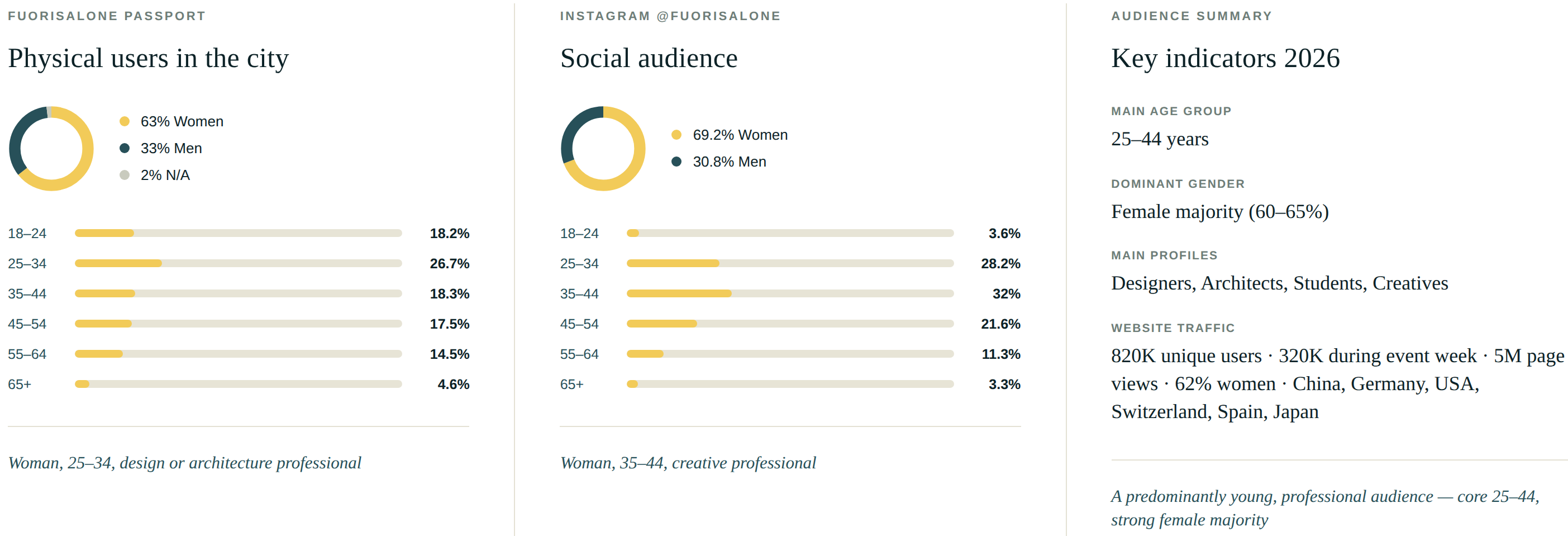
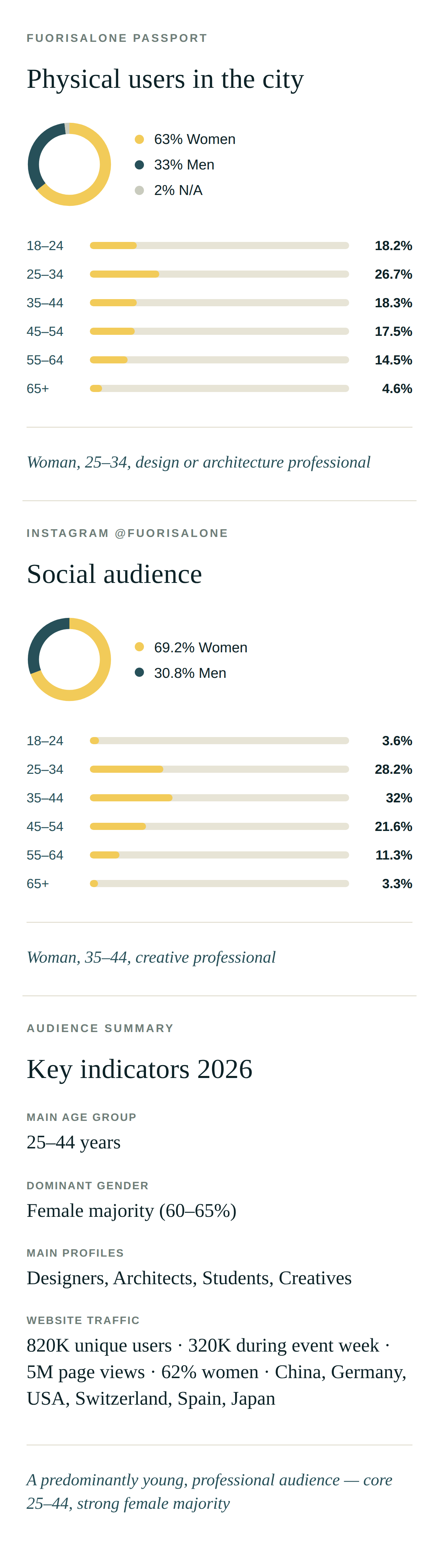
Fuorisalone 2026 Audience Profile
When storytelling is no longer enough
For years, Fuorisalone.it has acted as a guide through Milan Design Week, helping audiences navigate an ever-expanding system, making projects visible and connecting brands, designers, visitors and places.
Over time, however, that role evolved alongside the event itself. By observing how people search, choose, move through the city and participate, we gradually began to understand something that extended beyond individual exhibitions or installations. Every search query, saved event, itinerary, editorial interaction, Passport activation and survey response generated a trace. Viewed individually, these traces described specific actions. Viewed collectively, they began to reveal a much more complex map of the phenomenon. We realised we were no longer observing events alone. We were observing how people construct their journeys, how expectations shape behaviour and how relationships form between audiences, companies and places.
In other words, we were observing the behaviour of an ecosystem.
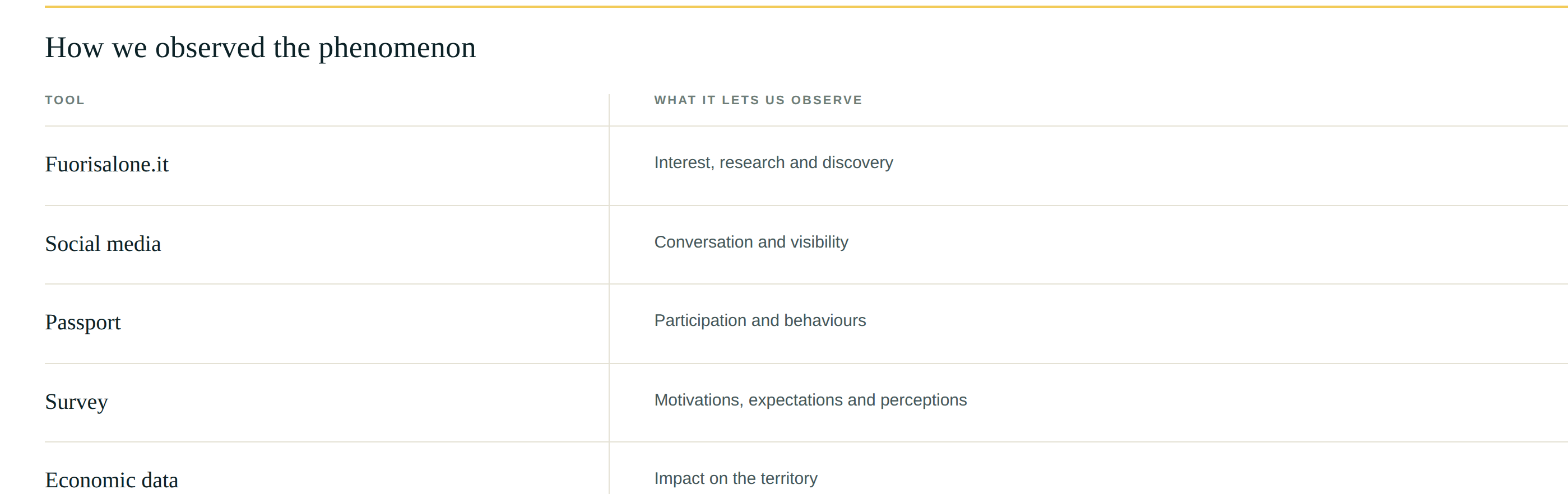
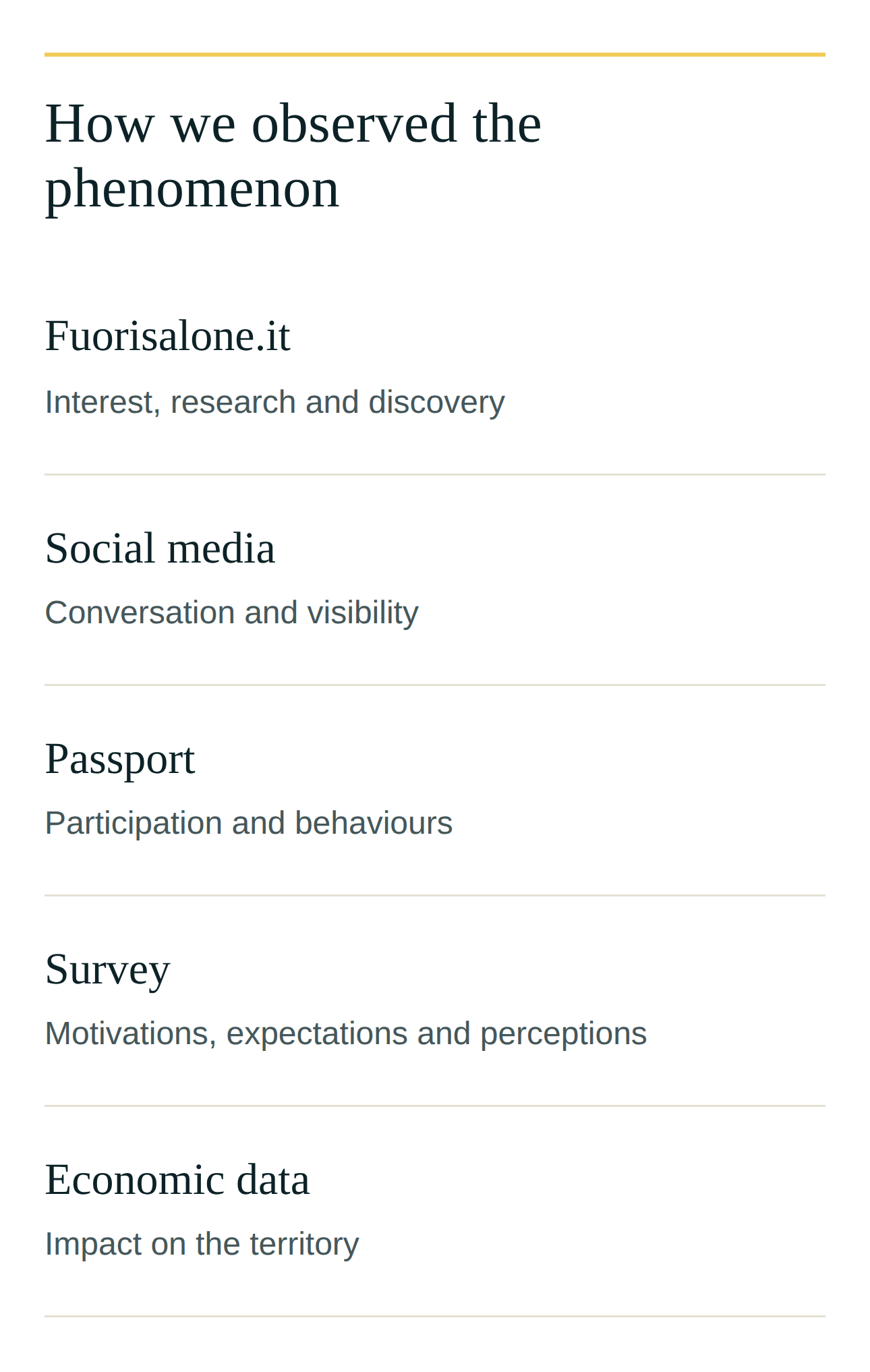
The tools of Fuorisalone.it
Perhaps the most interesting insight concerns the very nature of the sources we used. Accustomed to viewing data as objective measurement tools, we realized that each platform provides a different representation of the same phenomenon.
The website captures the moment of discovery, when people seek information, explore possibilities, and begin to chart their own course. Social media, on the other hand, captures the dimension of sharing, highlighting content that generates conversation, attention, and visibility, while Passport adds another layer of insight, allowing us to observe the choices actually made and real visitor behavior.
Taken individually, they seem like standalone stories. When viewed in relation to one another, however, the complexity of the system becomes apparent. We realized, for example, that the most searched-for events do not necessarily coincide with the most visited ones, and that the most photographed projects are not always the ones capable of generating the deepest engagement. Some content dominates public conversation, while other content builds more lasting and meaningful relationships within the professional communities that participate in Design Week. This is not a contradiction, but a key insight that emerged from the analysis. It reminds us that Fuorisalone cannot be interpreted through a single indicator or from a single vantage point. Each platform illuminates a different dimension of the experience, and each piece of data, taken in isolation, reveals only part of the story. It is at the intersection of these perspectives that the true nature of Fuorisalone is grasped. A phenomenon that cannot be reduced to rankings, numbers, or charts, but one that requires an interpretation capable of bringing together attention, participation, behavior, and relationships.
Platforms do not measure the same reality.
Each reveals a different dimension of Fuorisalone.
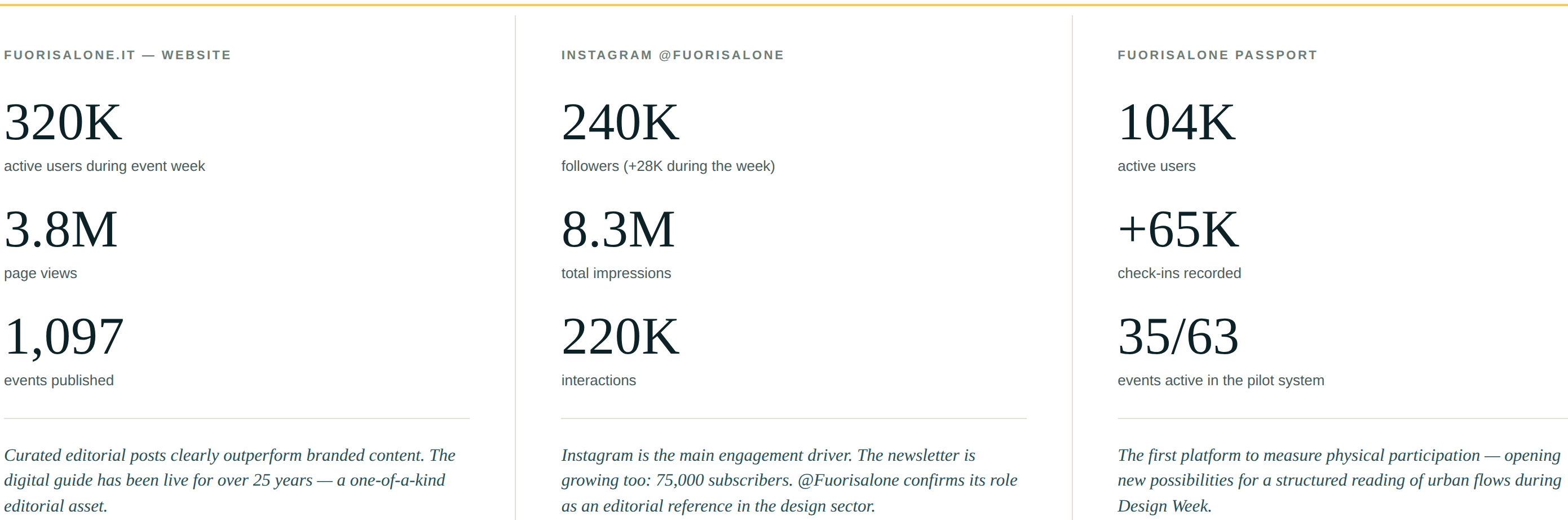
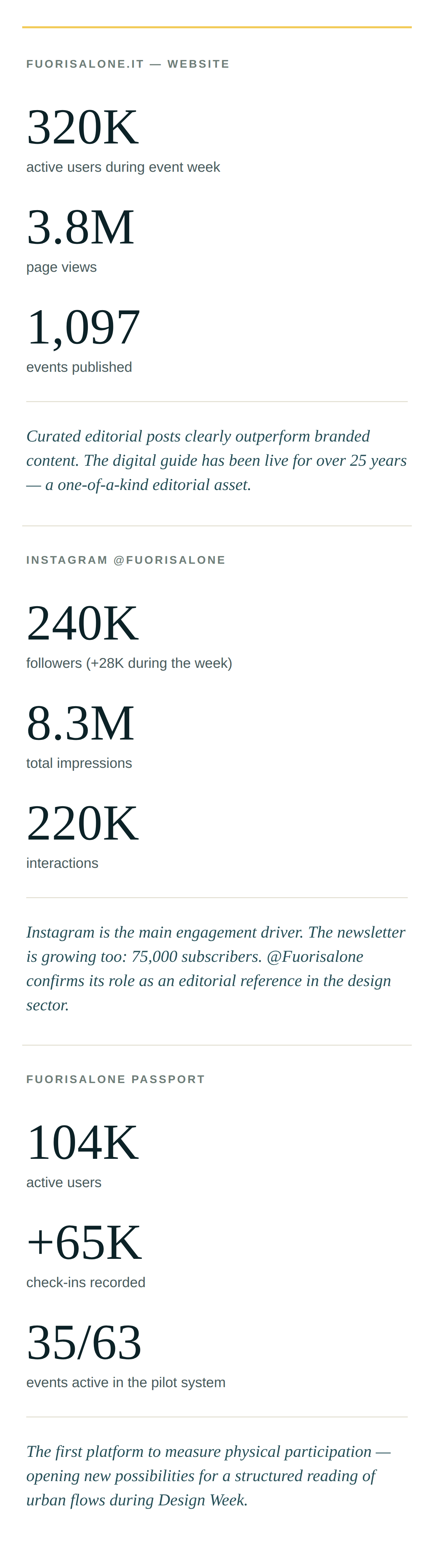
Data from the Fuorisalone.it platforms
A phenomenon that has changed in scale
When we begin to correlate economic data, visitor behavior, the origin of the audience, and the composition of participating companies, a picture of Fuorisalone emerges that often escapes our everyday perception. Those who experience it from the inside tend to view it through the lens of events, installations, and neighborhoods. The report, however, attempts to take a step back and observe the system as a whole.
The first obvious element is the shift in scale over the past few years. The 255 million euros in economic impact generated in a single week, the approximately 500,000 visitors in the city, and an international component exceeding 30% are not merely indicators of growth. They tell the story of Fuorisalone’s gradual transformation into a cultural platform capable of generating value beyond its original sector.
Companies, institutions, universities, media outlets, professionals, and creative communities all converge around Design Week, experiencing it as a space for exchange, learning, and connection—not merely as an exhibition.
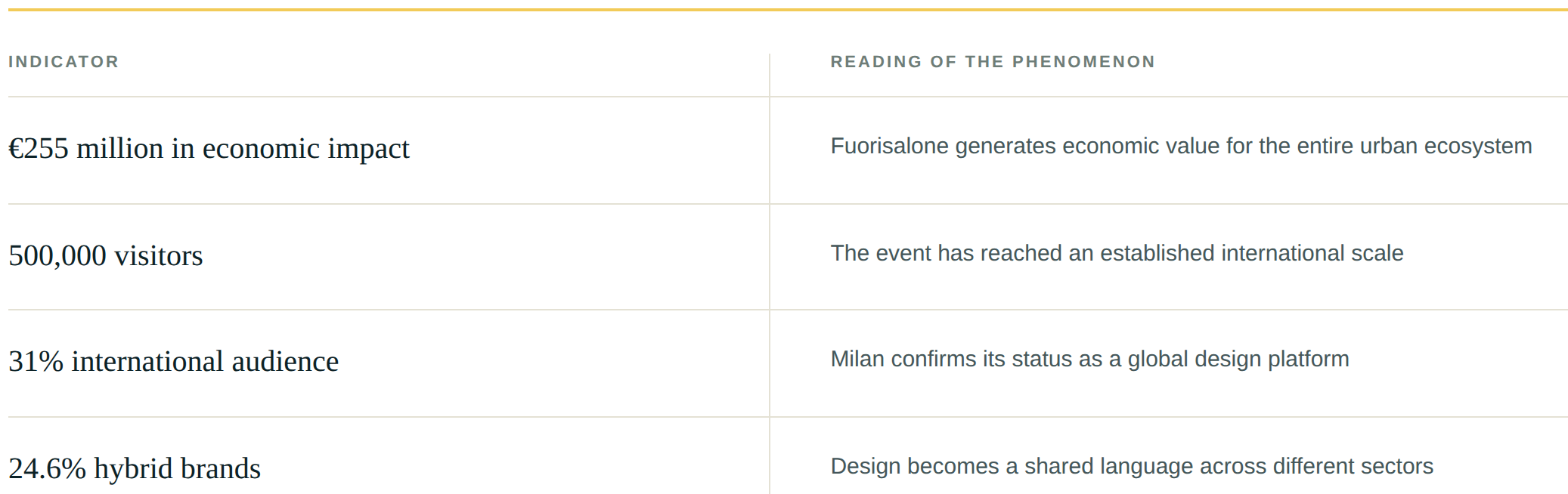
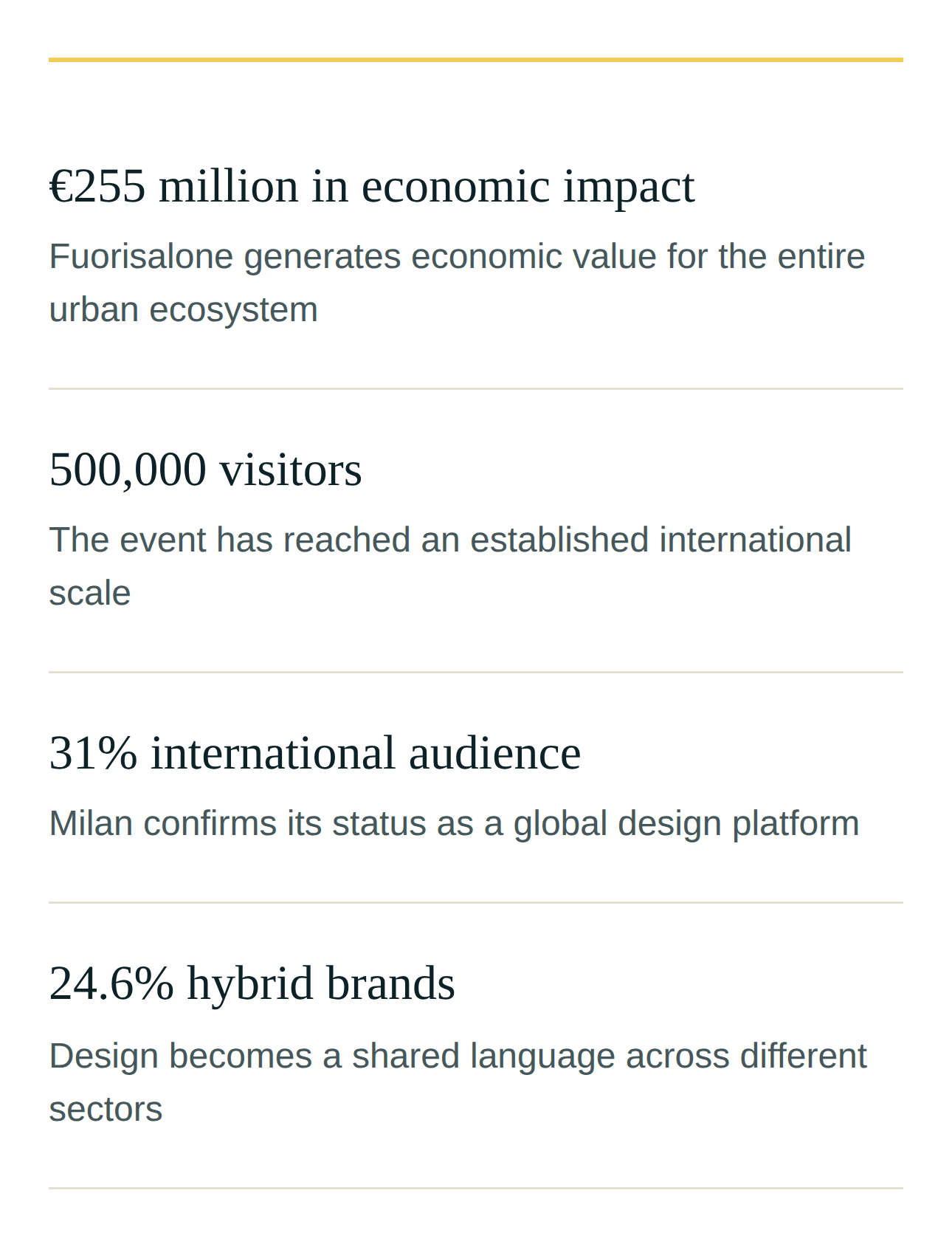
Data from Fuorisalone 2026
Among all the findings, one stands out in particular.
Almost one quarter of participating brands now come from outside the traditional design sector. Fashion, automotive, hospitality, technology, material research and contemporary culture occupy an increasingly significant place within the programme. For years this trend was interpreted as a departure from Fuorisalone's origins. The report suggests the opposite.
It is not that design has become less relevant. Rather, design has expanded its sphere of influence. Increasingly, different industries adopt the language of design, experience and storytelling as a way to generate meaning and build relationships with audiences.
In this sense, the growing presence of diverse worlds does not represent a deviation, but rather a confirmation of design’s ability to serve as common ground between different disciplines and industries. Fuorisalone is growing not only in scale, but also because it is becoming a space where different languages come together to generate cultural, relational, and economic value.
From abundance to choice
One of the most interesting insights to emerge from the Fuorisalone 2026 Report concerns the issue of direction. Whereas for years the challenge was to discover what was happening, today it is to choose what matters. The abundance of events has made Milan one of the densest cultural ecosystems in the world, and in this context, the problem is no longer access to information, but the ability to make sense of it. The issue is not knowing what is happening, but deciding what deserves attention.
This abundance, which is one of the great strengths of Fuorisalone, inevitably also creates a new complexity. Charting a course, selecting experiences, identifying connections, and prioritizing one’s choices becomes an integral part of the experience itself. For this reason, value no longer lies solely in the quantity of what is on offer, but increasingly in the ability to make it comprehensible and navigable.
This transformation pertains to Fuorisalone, but it speaks to something broader about our times, where, in a context saturated with content, the ability to navigate one’s way becomes a cultural skill. Perhaps today more than ever, understanding how we make choices is just as important as understanding what we choose.
The challenge is no longer finding events.
It is choosing between them.
An observatory of the present to shape the future
The Fuorisalone 2026 Report stems from a conviction that has solidified over time: understanding a phenomenon is the first step toward envisioning its evolution. The goal is to connect information, behaviors, and transformations, offering a framework for interpreting the system. Fuorisalone occupies a unique position within Design Week: we are not external observers analyzing the phenomenon in hindsight, nor are we merely organizers. For over twenty years, we have helped create the conditions that make it possible, through tools, content, and services that accompany the Design Week experience. This continuity of observation allows us to view the phenomenon from different perspectives and to grasp transformations that only become visible over time. Through our website, content, Passport, and surveys, we observe the phenomenon from multiple angles.
The report is not an endpoint, but the beginning of a journey. It is a way to understand what Fuorisalone is becoming, not just what it is. Because the future of Milan Design Week is not built solely by designing new events or devising new formats, but by developing the ability to understand the system that makes them possible, interpret its transformations, and recognize the signs that foreshadow its evolution.
In this sense, Fuorisalone tells a story that goes beyond design: it shows how cities change when they become cultural platforms and how the relationships between industries, people, and forms of expression evolve within the urban space.
© Fuorisalone.it — All rights reserved. — Published on 15 June 2026
 Iscriviti alla nostra newsletter