No longer a fragile, finite material, but a resource in transformation: rehub turns glass waste into revéro, a new mono-material free of resins or plastics
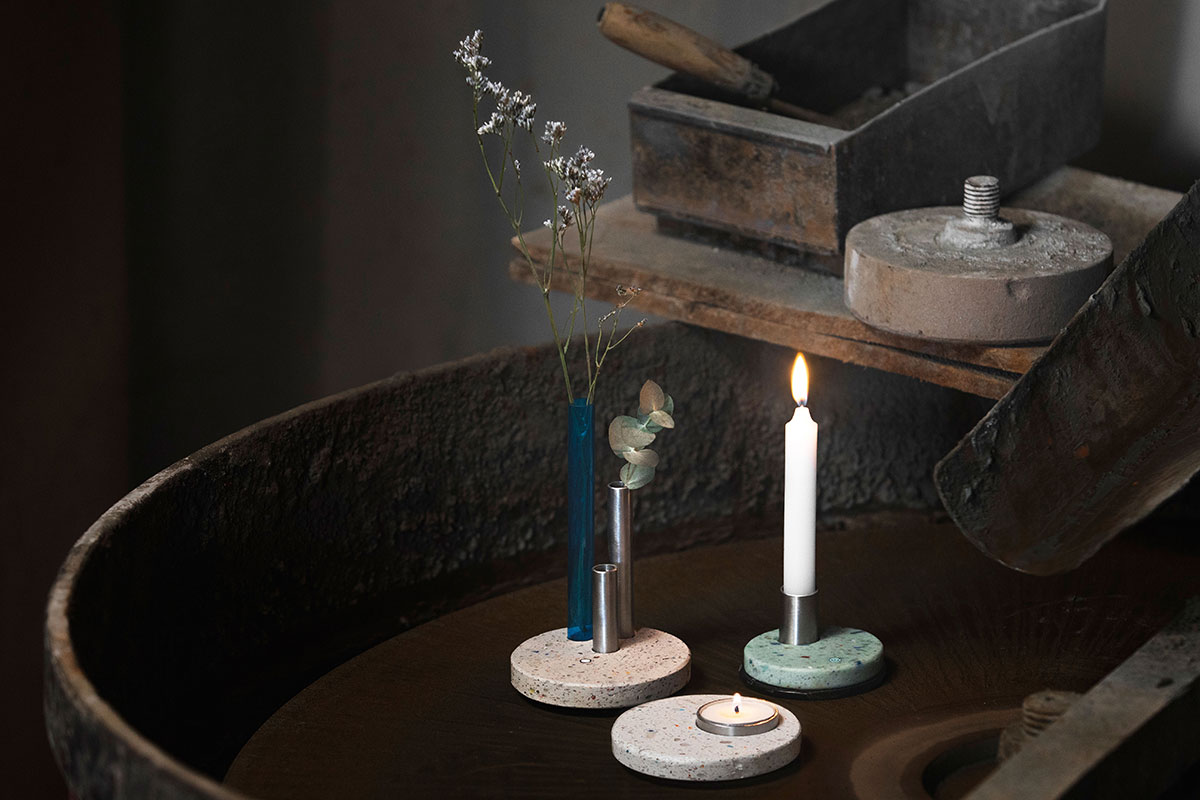
In Murano, where the thousand-year-old tradition of glassmaking meets the challenges of the present, rehub is redefining the future of glass. Founded by Venetian architect Matteo Silverio, the startup combines artisanal know-how with new technologies to give new life to the glass that, for technical or industrial reasons, cannot be recycled. Not all glass, in fact, can be melted down again: tableware, sheets, lamps, or windshields belong to a fragmented system excluded from traditional recycling processes. In Murano, for example, over 50% of annual production becomes waste - material that, due to the metallic oxides used for coloring, cannot be remelted and ends up in landfill. Companies pay to dispose of it, then buy new raw material, feeding an unsustainable cycle. From this awareness came revéro: a mono-material entirely free of resins and plastics, made only from waste glass. The glass powder is mixed with water and a natural blend of binders, creating a paste that can be shaped using common industrial techniques — rolling, injection, pressing, molding, and 3D printing with an in-house–developed extruder. We met Matteo during Edit Napoli and asked him to tell us more about his journey.
Courtesy of rehub
How did Rehub start, and what triggered the idea of rethinking the glass cycle?
I’ve been working in Murano for over ten years. I actually came here by chance, for what was supposed to be a short consultancy, at a time when I was only briefly back in Venice. But I never left: the island, its energy, the master glassmakers… they completely captivated me. During one of the many projects I was following — for Expo Dubai, in that case — I noticed the enormous amount of waste produced: defective pieces, broken ones, or those simply not perfect enough for delivery. I remember asking the glass master, quite naïvely: “What happens to all this?” His answer struck me: “We throw it away. We can’t melt it again. It goes to landfill.”
I think that’s when rehub was born. From that question. From there, I started to study the problem in depth — its environmental and economic impact — and to look for a way to turn that waste from a cost into a resource. It’s been a long process of experiments and trial and error, but everything started with that one simple, inevitable question.
Why do you call revéro a “silent revolution”?
Because it doesn’t make noise — it makes change. Revéro wasn’t born from a heroic act or a sudden stroke of genius, but from the stubborn observation of a problem and the will to solve it in a concrete way. It’s a revolution that doesn’t need slogans: it shows itself through facts — through the way something once considered waste becomes a resource again. I call it “silent” because it works within existing processes, quietly transforming them from the inside. It doesn’t want to replace tradition, but make it more conscious, more consistent with the time we live in.
Courtesy of rehub
What kinds of pieces or projects have you created so far?
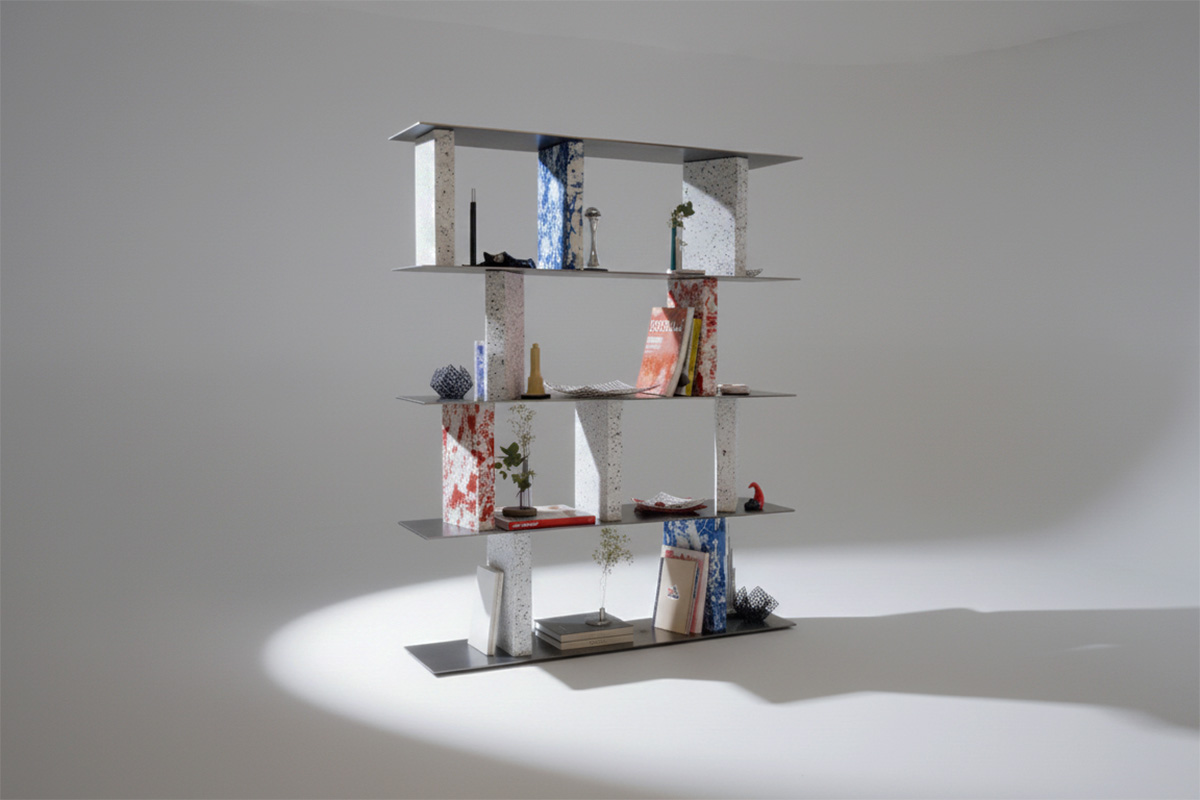
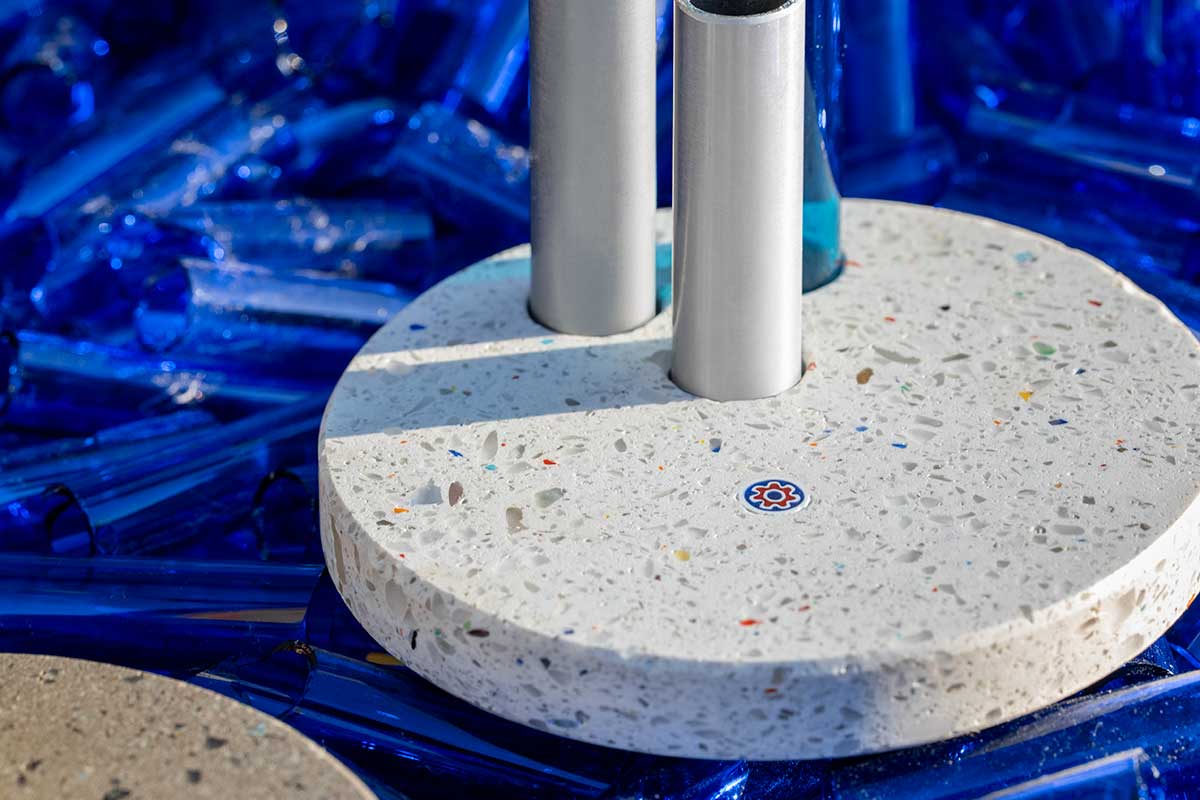
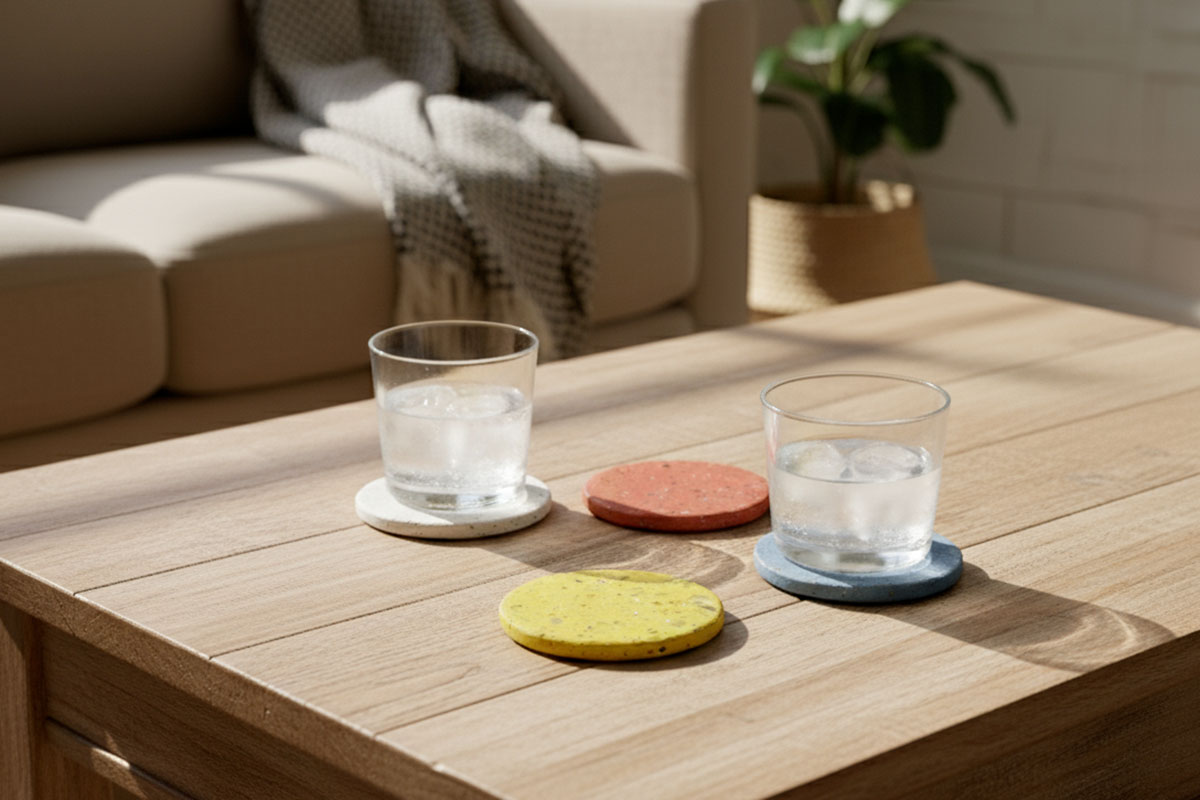
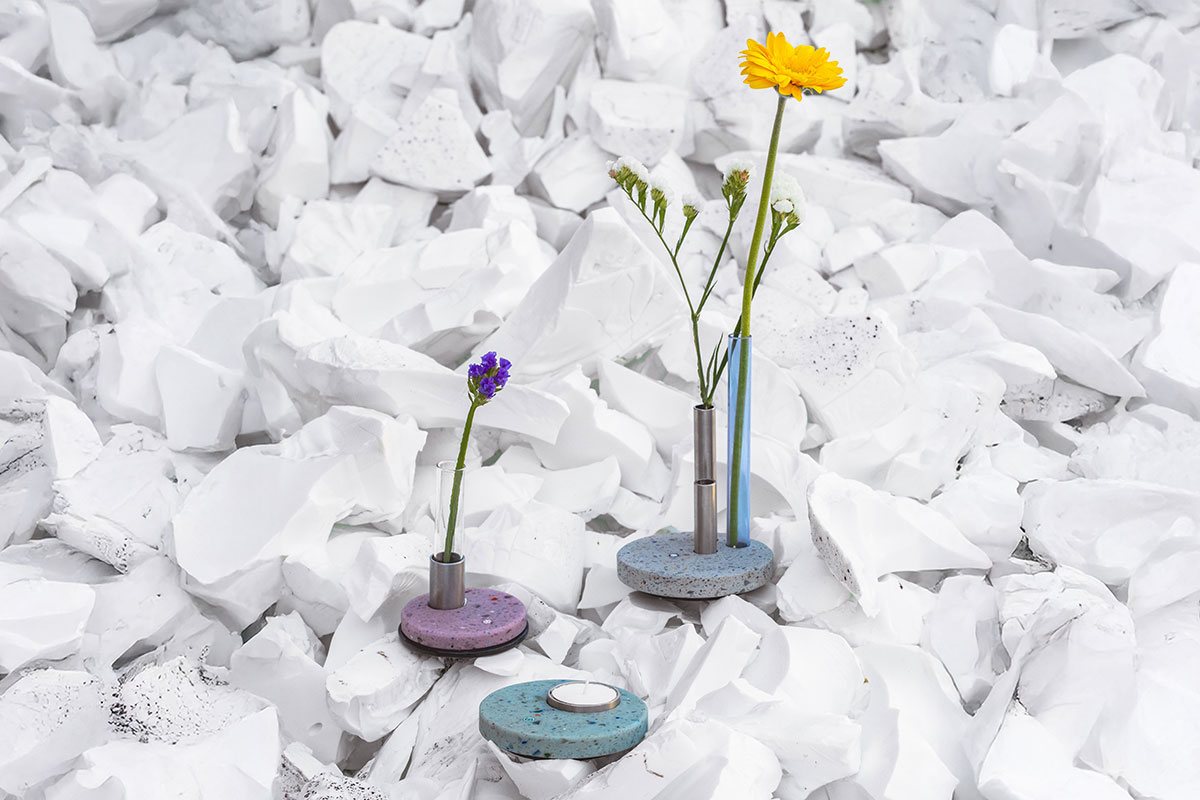
We mainly work B2B, developing custom projects that integrate with our partners’ needs, always keeping our focus on sustainability and responsible design. Research and experimentation are at the core of rehub. Many of our tests have turned into tangible objects: Nasse, for instance, were our first 3D-printed prototypes using our glass paste; then came the res collection — a series of small home objects made by pressing, with terrazzo-like textures and a material, almost architectural feel. From these experiences came more structured collaborations, such as those presented at Edit Napoli: with Rampinelli Edizioni, we created two coffee tables designed by Studio Sovrappensiero, combining metal and revéro surfaces in a balance of rigor and lightness; with Dante Negro, we developed Relire, a modular bookshelf exploring the material’s versatility and structural strength. It perfectly represents the spirit of rehub: research, matter, and form blending into something essential yet powerful. Some of our products are already available on our website and e-commerce, but our goal remains to develop new projects with brands and designers — pushing a little further each time what glass can become.
In a world where sustainability is everywhere, how do you keep it from turning into just a buzzword?
That’s something we think about a lot. Sustainability has become almost a trend — everything claims to be sustainable now — and that risks emptying the word of its real meaning. It can even harm those who work seriously and consistently. We try to approach it differently: by talking about it less, and showing it more. We share processes, data, collaborations, measurable results — without slogans or overstatements. People today are much more aware: they can immediately tell who’s greenwashing and who truly believes in what they do. In the end, transparency is the most honest — and credible — form of sustainability.
Courtesy of rehub
When glass takes on new properties - becoming more like stone or marble - how does that change our perception of it?
That’s a great question. People always approach our material with curiosity. They expect something light and glassy, but when they touch revéro, they’re surprised: it has a weight, a texture, a sound you don’t associate with glass. And when we explain that it’s made entirely from glass waste, there’s always a wow moment. In a way, revéro challenges the very idea of what glass “should be.”
I like to say that revéro is a child of glass, not its clone. It inherits some of its qualities — purity, chemical resistance — but takes its own path. It has a new identity: tactile, solid, and closer to stone than to transparency. It carries the memory of glass, but returns it in a new form.
What applications or collaborations do you envision for the coming years?
We’re a startup, but with a clear vision. We’ve developed a process that gives new life to material that used to end up in landfill. At first, we focused on small-scale experiments and objects, but over time we’ve evolved toward more efficient techniques that allow us to scale up.
We started with jewelry, then small home accessories, and now we’re moving toward surfaces and components for interior design and architecture — tabletops, walls, claddings. It’s a natural evolution of the material: born from craft, but with huge industrial potential. We’re working to make the process scalable without losing the soul of the project. It’s a complex path — it takes time, resources, and the right partners — but also the most exciting part: seeing how a material born from waste can become the protagonist of new spaces and design languages.
Courtesy of rehub
After exploring both the limits and possibilities of glass, what continues to fascinate you about it?
I stayed in Murano because glass completely captivated me. It’s an ancient, almost primordial material, worked like molten lava — alive, unpredictable, constantly transforming. It’s probably the only material you can’t really work with at home: it requires structure, tools, and above all, knowledge. That’s what makes it so fascinating — and, in a sense, humble. After more than ten years, I’m still learning something new every day. Like every love story, it has evolved: at first, I was attracted by the colors, the forms, the visual magic. Now I’m fascinated by the matter itself — its composition, chemistry, the way it reacts and behaves. I study formulas, tests, mixtures — and each experiment opens a new door to an unexplored world. And I’m not alone: the rehub team is young, curious, and shares the same passion for this material and its untapped potential. That shared curiosity — more than technology or design — is what keeps our work alive every day.
This year’s Fuorisalone theme is “Be the Project.” What does that mean to you?
For us, the process is everything. It’s the most alive and authentic part of our work — where things actually happen. I’ve always been obsessed with processes, not only technical ones but human ones: relationships, exchanges, even mistakes that lead to new solutions. Revéro itself is not so much a material as it is a method — a process that can generate infinite forms and applications. So yes, in a way, being the project is exactly what we do every day: living inside the process, rather than just producing an object.
Courtesy of rehub
Rehub was born from the desire to rethink what already exists. In this “re-design” process, how important are error and failure?
Honestly, rehub wouldn’t exist without error. Working with waste means living with the unexpected: every time you think you’ve found the perfect formula, something proves you wrong. But that’s the beauty of it — sometimes a crack, a defect, or a “wrong” color becomes the most interesting thing.
In our lab, we have a simple rule: never say no. Mistakes — and even failure — are welcome. They’re part of the process. We’re a startup: failure, in the end, is probably the only certainty… but also the most honest way to learn something new.
Tag: Design Vetro di Murano Sustainability Interviste Be the Project
© Fuorisalone.it — All rights reserved. — Published on 04 November 2025
 Iscriviti alla nostra newsletter