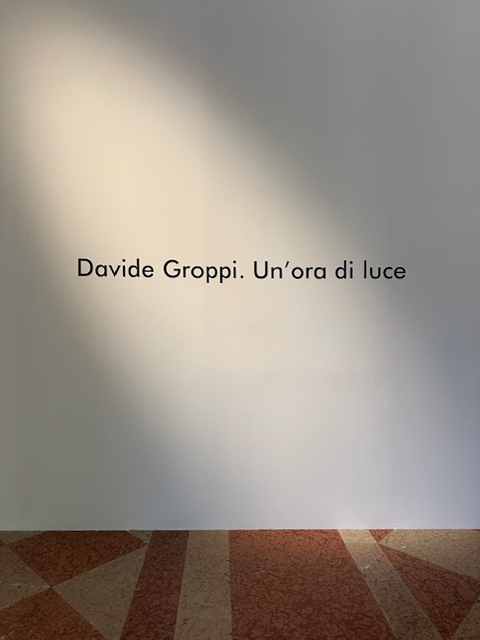
Davide Groppi. Un’ora di luce
Curated by Marco Sammicheli
Venue: Volumnia, Stradone Farnese 33, Piacenza
Dates: March 26 – May 26, 2026
Opening hours: Monday – Saturday
10:00 am – 1:00 pm
3:00 pm – 6:00 pm
Admission: free
In the spaces of the former Church of Sant’Agostino in Piacenza, an exhibition curated by Marco Sammicheli transforms light into experience, shaping a journey through space, time and perception
Davide Groppi is often described as a master of light, yet rather than constructing it, his work seems to reveal it. For over forty years, he has developed a language that reduces design to its essentials, working through subtraction until the object disappears, leaving space for effect, relationship and atmosphere to emerge. His path, which began in the late 1980s in Piacenza, has developed independently, far from trends and conventions, maintaining a rare coherence that spans products, installations and architectural interventions. In this sense, for Groppi, light is not a technical medium but a form of thought, a device capable of shaping space and generating experience.
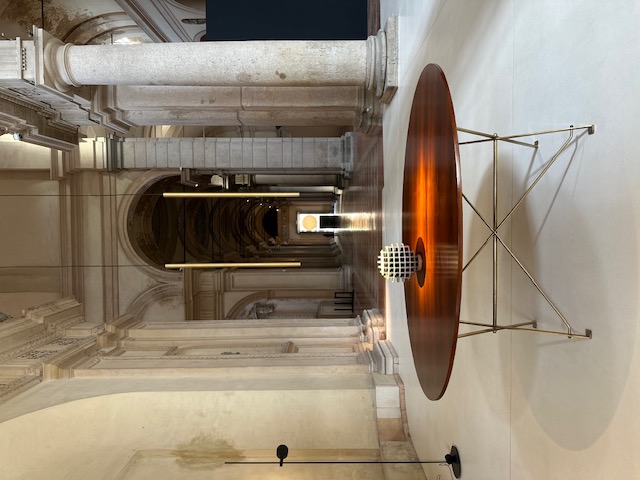
It is in Piacenza that this journey returns with Un’ora di luce, the anthological exhibition curated by Marco Sammicheli and hosted at Volumnia, within the former Church of Sant’Agostino. The connection between the designer and the place is not only geographical but also project-based: Groppi had already worked on the lighting of the space in 2018, contributing to define its current identity, suspended between historical memory and contemporary use. Volumnia is not simply an exhibition venue, but a cultural device built on stratification.
Born from the restoration of a Renaissance basilica, it takes shape as a space where architecture, memory and design coexist without hierarchy, bringing together historical furnishings, art and contemporary design. The vision of its founder, Enrica De Micheli, transforms what was once a sacred place into an environment open to experimentation, where every intervention is required to engage with a strong historical presence that is never neutralized. In this context, Groppi’s light does not overlay the space but moves through it, activating new readings and establishing an ongoing dialogue between permanence and transformation.
More than a traditional retrospective, the exhibition presents itself as an experiential device. Sammicheli constructs, together with Groppi, a path that does not follow a chronological logic, but unfolds as a sequence of environments and situations designed to trigger a state of attention and wonder in the visitor. The title itself introduces a temporal dimension: “one hour” is not an objective measure, but a mental condition, a suspended time in which light becomes a narrative material. The installation unfolds along the main nave of the church through geometric and metaphysical volumes that articulate the space, creating a system of thresholds, passages and pauses. The entrance is marked by the MOON lamp, defining a transition between inside and outside, leading into a sequence of white architectures where lamps appear as autonomous presences, almost like suspended torches. In this context, light does not simply illuminate objects, but constructs relationships, reveals tensions and activates perception.
Within the exhibition path, some of the projects that have defined Groppi’s research emerge—more or less explicitly—becoming over time archetypes of his language. Lamps such as Sampei, born from the intuition of a fishing rod transformed into a luminous gesture, or Nulla, reduced to a simple aperture from which light manifests without a body, define an approach based on subtraction and displacement of meaning. Moon, with its Japanese paper surface, translates a universal image into a domestic presence, while Anima creates a thin, immaterial figure suspended between sign and light. In these works, as in the new pieces presented in the exhibition, the object loses centrality to make room for perceptual experience, confirming a research that runs throughout his entire production.
The path opens with five “light utopias”, unique pieces positioned between possible and impossible, between nature and artifice, and continues through a sequence of inhabited walls where light appears in unexpected forms, at times denying function and rationality to assume a poetic dimension. Along the way, the projects engage in dialogue with the history of the space and with the objects present in Volumnia, creating a stratification between past and present in which light acts as a connective element.
The exhibition also features new works, such as the UMASI lamp presented as a preview, and VERA, a limited edition developed for Volumnia, in which the light bulb appears as a hologram, transforming a technical element into a perceptual illusion. These interventions confirm a research that does not focus on the object itself, but on the ability of light to generate surprise, ambiguity and relationship.
In this framework, Un’ora di luce reflects the coherence of a path in which design does not coincide with a final form, but with a continuous process of redefinition between space, perception and meaning. Light, freed from its purely functional dimension, becomes a language through which to question the relationship between visible and invisible, presence and absence. It is within this tension that Davide Groppi’s work stands today as one of the most radical interpretations of contemporary design, capable of translating into experience the idea of design understood not as an object, but as a condition.
“Un’ora di luce” introduces a temporal dimension rather than a spatial one. For you, is design something that is constructed in space or in time?
D.G. Although I constantly search for a method, design is not an exact science. Personally, I cannot think of design as anything other than something that happens in time. What we ultimately experience is a spatial result, but the process is about time. There is a time to design, to create, to make mistakes, to go back, to start again, and eventually to reach a condition where you feel you have explored all possibilities. And there is a space-time, between the idea and its realization, which I find very fascinating.
In your work, design tends to disappear as an object and become an experience of light. In this sense, design is no longer something you see, but something that happens: is this your way of “being project”?
D.G. I imagine my light as something that seduces and draws people closer. For me, lamps are attractors of attention, indicators of meaning and, ultimately, instruments of vision.
The theme “Being Project” emphasizes process, error and transformation. In your path, which is extremely coherent, where does error come in? Is there still space for the unexpected in your research?
D.G. Very much so. I prefer the field of design where you don’t quite know what you’re doing. Even if I start from an intuition, I let myself be guided by experimentation, by the possibility of trying and therefore stumbling upon something unexpected. At that point, experience and craft take over and do their rational work.
Your light does not simply illuminate spaces, but redefines them. Can we say that in your work design does not create objects, but relationships? And if so, between whom or what?
D.G I see light as something almost indescribable; there are no precise words to define it. For me, light is certainly vision, but also meaning. Lamps are companions, comforting presences, tools of connection, actors in the theatre of our inhabited spaces. Between energy and form, between function and imagination, between what illuminates and what is illuminated, lamps are domestic creatures. They live in their silent presence and tell stories of design, project and everyday life.
After many years of working with light, what still surprises you? And where do you think this research can take you today?
D.G. What still surprises me, every time, is the sense of wonder that some lighting projects generate in people. I am also surprised by the possibility of expressing my inner self through lamps and seeing how others are able to recognize themselves in them.


 Iscriviti alla nostra newsletter