From industrial products to cultural systems, from sustainability to accessibility: the XXIX edition of the award reflects a form of design capable of reading the complexity of the present
More than seventy years after its creation, the Compasso d’Oro continues to be much more than an award. Established in 1954 from an idea by Gio Ponti and La Rinascente, the recognition promoted by ADI has always functioned as a tool for interpreting the present through design, capable of intercepting industrial, cultural and social transformations even before aesthetic ones. And the XXIX edition, awarded on Friday 22 May at the ADI Design Museum in Milan, seems to confirm this with particular clarity. More than a simple selection of products, Compasso d’Oro 2026 in fact outlines a map of contemporary design in which objects, services, systems, research and communication increasingly tend to overlap. It is no coincidence that the jury’s motivations strongly emphasise the idea of a design “less and less confined to the dimension of the object and increasingly oriented towards the construction of complex systems”: a form of design that today engages with environmental responsibility, infrastructure, the transformation of work, inclusion and social impact.

© MDFItalia Array Snohetta © shestakovych studio
The international jury - composed of Giovanna Carnevali, Lorenza Baroncelli, Giovanni Brugnoli, Luciano Galimberti and Jasper Morrison - awarded twenty projects that clearly reflect this direction, crossing very different sectors and scales. Alongside strongly industrial projects such as the Bilboquet table lamp by Philippe Malouin for Flos, there are works addressing much broader themes: +Vicino da lontano, developed by Anako together with several international universities to improve the lives of refugees; Felix R by Loccioni, a railway robot based on artificial intelligence; or Nuance, an acoustic device developed for Luxottica that works on the relationship between wearable technology, wellbeing and accessibility. Among the winners, there is also a strong focus on sustainability as a concrete issue and no longer simply a declared one. This is the case with Array, the sofa designed by Snøhetta for MDF Italia, which works on reducing weight, components and materials through a fully circular approach; but also Trespolo by Giulio Iacchetti for Orografie, a stool-side table reflecting on typological essentiality through a design gesture reduced to the minimum, or the D’Antan armchair by Raffaella Mangiarotti for De Padova, which reinterprets the language of classic upholstery in an understated and contemporary form.
Compasso d’Oro in the Design for Social Impact category awarded to IED’s The Glitch Camp, the first free urban campsite for international students during Milano Design Week, recognised for its inclusive and collective approach.

PALAZZO CITTERIO - GRANDE BRERA
At the same time, the 38 Honourable Mentions further broaden the field, creating a heterogeneous constellation spanning furniture, publishing, mobility, healthcare, museums, urban planning and communication. Among them are Palazzo Citterio - Grande Brera, designed by Mario Cucinella for the Pinacoteca di Brera, an example of how museum design today increasingly works on the relationship between architecture, public space and cultural accessibility; the Ferrari 12Cilindri, the Nico collection by Minotti, the Origata sideboard by Porro and the Continuum D.163.7 armchair by Gio Ponti reissued by Molteni&C and Bonacina1889. Also among the mentions are SuperWire by Flos designed by Formafantasma, the podcast “Cosa c’entra” by Chiara Alessi for Il Post and Museo Egizio: progettato per tutti, disegnato su ciascuno, a project dedicated to museum accessibility. Signs of how Italian design today increasingly moves between industrial research, cultural production and social responsibility.

SEDIA '64_CAPPELLINI, AG Fronzoni, 1964
Alongside the main awards, the Compasso d’Oro alla Carriera was assigned to figures who have shaped Italian design culture in different ways: Giovanni Arvedi, Oscar G. Colli, Aldo Colonetti, Lorenzo Delladio, Pietro and Antonio Galimberti of Flexform, Paola Lenti, Alberto Meda, Patrizia Moroso and Antonio Romano. Three awards were also dedicated to historic products that have entered the collective imagination of Italian design: the Sedia ’64 by AG Fronzoni for Cappellini, the Tavolo Eros by Angelo Mangiarotti for Agape and the famous Tavolo con ruote by Gae Aulenti for FontanaArte. Added to these are the Targhe Memorabili dedicated to Claudio De Albertis, Rodolfo Dordoni and Francesco Trabucco. Finally, a look towards the younger generations with the three Compasso d’Oro Young awards assigned to Sentimetro by Alessandro Brutti, StainEraser by Beatrice Duina, Filip Malata and Francesca Corona, and Uno by Erik Bruno Kollmorg and Vincenzo Magni. Different projects, yet united by the idea that today design can no longer limit itself to form: it must produce relationships, imagine scenarios and take a position in relation to the complexity of the present.
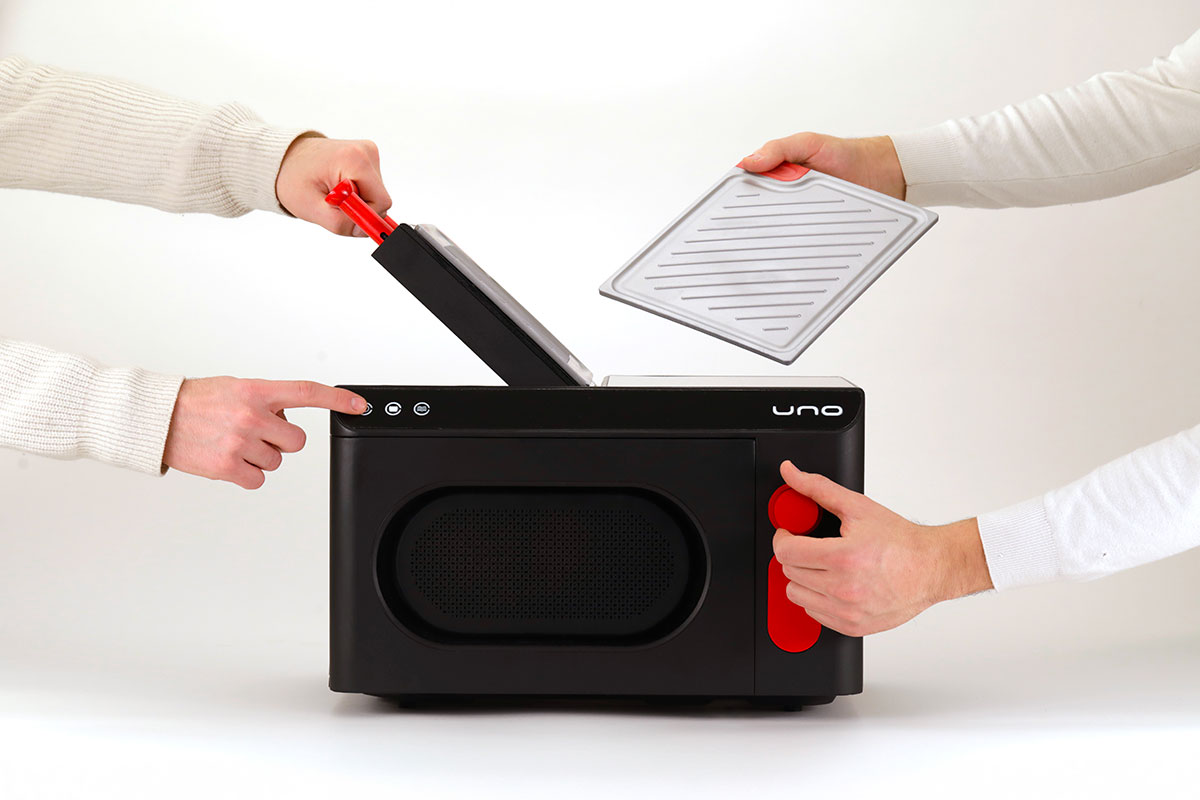
Uno - Erik Bruno Kollmorgen e Vincenzo Magni
Tag: compasso d'oro adi design museum Awards Design
© Fuorisalone.it — All rights reserved. — Published on 25 May 2026
 Iscriviti alla nostra newsletter