Warmer, more decorative and more tactile, metal is leaving behind industrial and high-tech imaginaries to become one of the most compelling protagonists of contemporary design
At Milan Design Week 2026, metal was everywhere. But not in the way we expected. No longer just polished steel, high-tech surfaces or industrial aesthetics linked to technological minimalism. This year, metal changed character: it became warmer and more decorative. It is an interesting transformation, coming after years dominated by the “cold” metal of neo-futurism and mirrored surfaces. A sort of soft industrialism that runs through collectible design, installations and new ways of living.
_1_1_1_1_1_1.jpg)
Casa NM3
We saw it at Casa NM3, the installation with which the studio founded by Delfino Sisto Legnani, Nicolò Ornaghi and Francesco Zorzi - long associated with a radical use of steel - transformed its headquarters on Via Farini. Inspired by the Velvet and Silk Café designed in 1927 by Lilly Reich and Ludwig Mies van der Rohe, soft curtains defined pathways and pauses, while steel storage systems, a kitchen, rugs and the designers’ personal objects created an intimate environment. De Castelli, together with Antonio Marras, also explored a more narrative dimension of the material. In The Geometry of Chaos, presented in the brand’s showroom, screens, lamps, mirrors and oxidized surfaces transformed brass and copper into elements with a strong decorative presence, suspended between design, craftsmanship and storytelling.
4.jpg)
Lare, Millim Studio × Poignée © Eller Studio
Among the more experimental projects, particularly noteworthy was Lare, an aluminium cabinet designed by Millim Studio for Poignée and exhibited at Spazio Vito Nesta. Inspired by the idea of the fireplace as the centre of domestic life, it transforms metal into a vibrant surface: the satin finish and the thin angled fringes capture and fragment light, generating constantly shifting reflections that amplify its decorative dimension. At Alcova, we were drawn to the Glimpse Floor Lamp by the Ukrainian duo Anna and Sergii Baierzdorf of Furn Object. Sculptural in nature, the lamp combines metal and glass in a vertical composition of soft volumes and carefully calibrated openings that modulate the diffusion of light. Also at Alcova, we noticed Rayos Hanging Lamps by Pepe Valenti, part of the Chromo Genesis collection, which use chromed and reflective surfaces to transform light into a design material, playing on the continuous relationship between object, environment and observer. At Villa Pestarini, we saw Ango Lare, a 2026 project by Boccamonte that continues Luisa Castiglioni’s research into the traces and behaviour of light sources. The lamp interacts with two converging walls, to which two mirrored triangles are attached, fixed at an angle and hinged together. A bridge LED projects light onto the mirrors, redrawing and expanding the physical boundaries of the room.
_1_1_1_1_1.jpg)
Metalia, Natalia Criado e Laboratorio Paravicini
The same tension between function and sculptural presence also emerged in Silhouettes: Celebrating 15 Years, the exhibition through which Muller Van Severen celebrated fifteen years of research during Design Week. Presented at Ordet with Apartamento and Tim Van Laere Gallery, the exhibition brought together large aluminium candelabras in which metal lost its functional rigidity to become sign and presence. More intimate, yet perfectly aligned with this sensibility, was Metalia, the project presented by Natalia Criado with Laboratorio Paravicini on Via Nerino. The collection combined Paravicini’s hand-painted ceramics with Criado’s metal objects - bowls, cutlery, cups and aperitivo accessories - transforming material contrast into a narrative about the contemporary rituals of the table. In The Invisible Table, the objects appeared suspended in space, almost stripped of their weight. At Deoron, we were impressed by The Incremental Collection by Finnish designer Vincent Laine. The collection explores the transition from a simple sheet of stainless steel to a chair through a series of progressive folds that define structure and backrest in a single gesture.
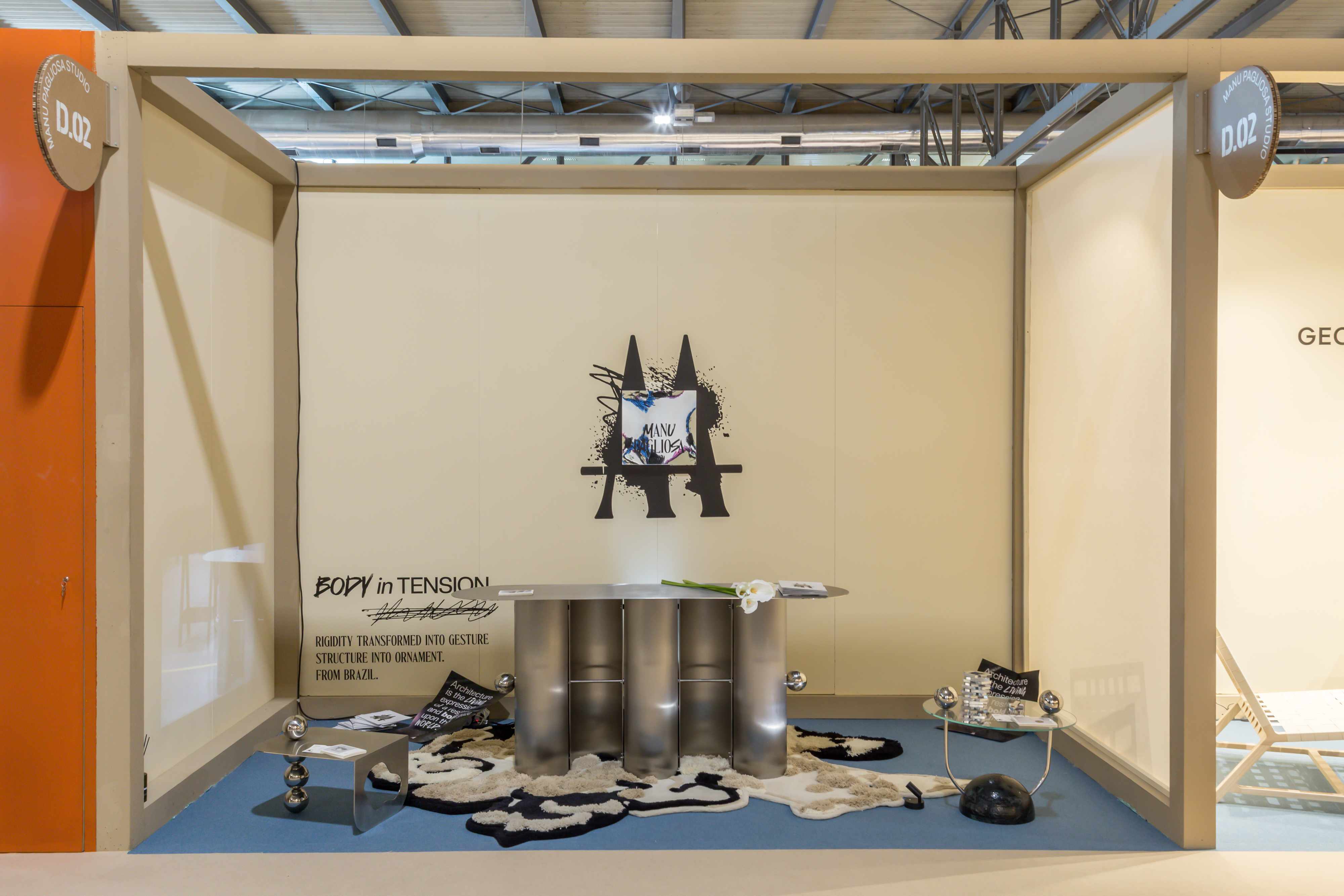
Body in Tension, Manu Pagliosa
An exercise in reduction that entrusts the material itself with the construction of form. Yet the exploration of metal does not pass through structure alone. At SaloneSatellite 2026, the work of Brazilian designer Manu Pagliosa also stood out: Body in Tension, a collection in which metal is treated almost like skin, bent and rendered more fluid and corporeal, far removed from traditional industrial rigidity.
That this reading extends beyond Milan Design Week is confirmed by ELEMENT: METAL, the exhibition hosted in May at Schloss Hollenegg, Austria, and curated by Alice Stori Liechtenstein. More than a survey of a material, the exhibition brought together designers such as Sabine Marcelis, Philippe Malouin, Max Lamb, Junko Mori and Ildar Wafin around the many expressive possibilities of metal, spanning craftsmanship, formal research and contemporary experimentation. More than the return of a material, what emerged in 2026 seems to be a shift in perspective: metal is no longer used solely to express precision and performance, but also to create atmospheres, narratives and new forms of domesticity.
Tag: Milano Design Week Fuorisalone 2026 Product Design Design
© Fuorisalone.it — All rights reserved. — Published on 08 June 2026
 Iscriviti alla nostra newsletter